TL;DR

Get bike and ride gear delivered free with Prime
- Fast, free delivery on millions of items
- Prime Video, Amazon Music and more included
- Member-only deals all year
In the early 1900s, electric-car makers marketed their vehicles to women, highlighting that they were easier to start and quieter than gasoline cars. Fannie Goodnow’s 1908 Bailey Victoria Phaeton illustrates how owners charged early EVs at home, but a roughly 64-to-80-kilometer standard range and a 12-hour charge reflected the limits of the technology.
Early electric-car makers marketed their vehicles to women in the early 1900s, promoting easy starting and quiet operation as alternatives to the hand-cranked, noisy gasoline cars of the period. An account published by IEEE Spectrum documents that sales strategy through General Electric advertisements and the 1908 electric car owned by Fannie Goodnow, showing both the appeal and practical limits of early EVs.
Before gasoline cars gained electric starters in 1911, drivers had to start their engines with a hand crank. Once running, those cars were loud and produced exhaust. An electric car could be started by switching on its battery, often with a key, and produced no exhaust at the vehicle. The IEEE Spectrum account says manufacturers used those features to distinguish electric cars and position them as suitable for women. Electric cars were also advertised to doctors who needed to make nighttime house calls without disturbing neighbors.
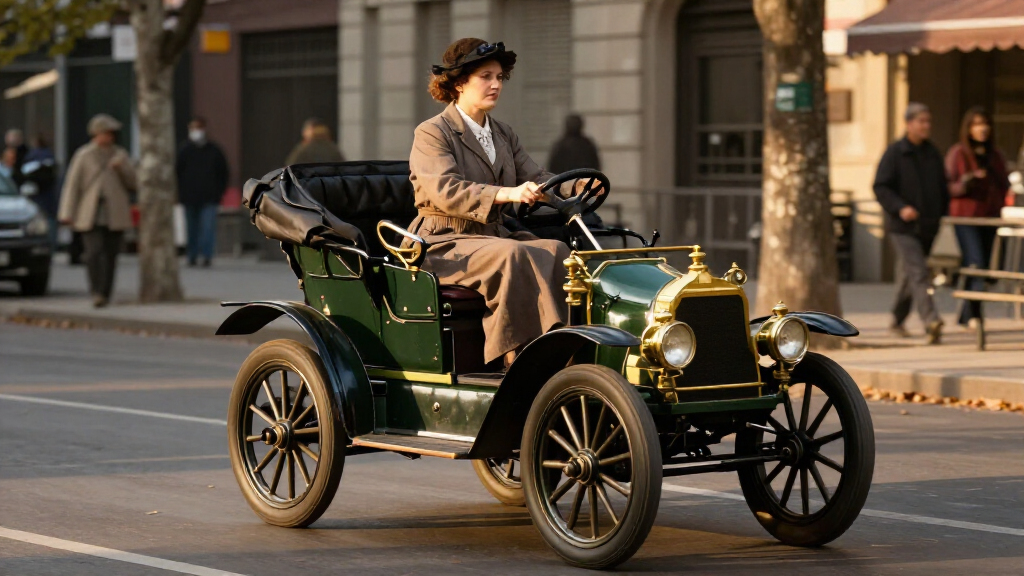
General Electric, which made chargers using mercury-arc rectifiers, published advertisements showing stylishly dressed women connecting cars to charging equipment. Goodnow, described in the report as an early EV adopter, owned a 1908 Bailey Victoria Phaeton, an open two-seat vehicle, and charged it with a GE rectifier. The device converted alternating current from the power grid to direct current for the battery. A depleted battery took about 12 hours to charge.
Goodnow’s car used a 30-cell lead-acid battery mounted beneath the chassis in a wooden box. The standard battery offered a stated range of 64 to 80 kilometers; a larger version with 50 percent more capacity was available for an additional cost. Those figures help show why the early electric car’s quietness and ease of use did not solve the period’s broader problems: charging required planning, and long-distance travel infrastructure was limited.
What Early EV Marketing Reveals
The episode shows that electric cars were not always framed as a niche product for technology enthusiasts. In a market where steam, gasoline and electric vehicles competed, manufacturers sold EVs around the everyday experience of driving: simple starting, quieter operation and no tailpipe exhaust. The gendered advertising was a commercial choice, not evidence that women were the only customers or that electric cars were exclusively intended for them.
The story also puts modern discussions of EV convenience in historical perspective. Early owners could avoid hand-cranking and fumes, but faced a long charging time and limited range. Goodnow’s car depended on a home charging setup, while the report says charging and long-distance travel infrastructure remained challenges. The trade-off between ease of local use and constraints on range and charging was present from the industry’s early years.
Popular right now

Dyson Car+Boat Cordless Handheld Vacuum

Shark Rocket Pet Plus Corded Stick Vacuum, Lightweight, Bordeaux, HV322

Apple AirPods Pro 3 Wireless Earbuds with Active Noise Cancellation
As an affiliate, we earn on qualifying purchases.
A New Industry, Competing Technologies
At the turn of the 20th century, the U.S. automobile industry was expanding quickly. The IEEE Spectrum report gives an estimate of about 50 American carmakers in 1898, rising fivefold by 1908. It says production grew from 7,000 vehicles in 1901 to 181,000 in 1910. Electric vehicles competed with steam and internal-combustion cars, and no technology had yet secured lasting dominance.
Bailey’s company entered the electric-car business as its established carriage trade came under pressure. S.R. Bailey & Co., a Massachusetts carriage maker, announced in December 1906 that it would produce electric vehicles. Its first Victoria Phaeton used an Edison alkaline battery. The report says that battery leaked and failed to hold a charge, prompting Bailey to switch to a lead-acid battery supplied by Gould Storage Battery Co. By 1910, Edison had a better battery in production, but Henry Ford’s Model T was helping establish gasoline cars as the dominant choice.
The charging equipment had its own engineering history. Electrical engineer Peter Cooper Hewitt is generally credited with inventing the mercury-arc rectifier, a device that allowed current to flow in one direction. The report notes that later patents by Percy H. Thomas advanced Hewitt’s designs. In a car charger, the rectifier’s mercury vapor and carbon anodes enabled conversion from grid AC to the DC required by the vehicle battery.
“Electric carmakers looking for a way to differentiate their products decided that these attributes made their vehicles perfect for women.”
— IEEE Spectrum report
What the Historical Record Cannot Show
The reason Goodnow chose an electric car is not established in the report; it says no records explaining her decision were found. The account also does not establish how representative she was of early EV owners, how widely women bought electric cars, or how much the advertisements affected sales. The marketing examples show how companies presented the vehicles, not the full experience or preferences of their customers.
Range and charging figures are reported for the Bailey battery configuration, not as universal performance measures for every electric car of the period. The report does not give a date or broader market data showing exactly when electric vehicles lost ground to gasoline models. It describes the Model T as setting the stage for the internal-combustion engine’s market takeover, but the shift involved more than one factor.
Reading the Evidence in Its Era
There is no new policy or product milestone attached to this historical report. Readers can compare the documented advertisements, vehicle specifications and charging technology with other surviving records to learn more about who bought early electric cars and how they used them. Any broader claim about women’s share of the early market would require sales or ownership records beyond the examples cited here.
Key Questions
Why did early electric-car makers market EVs to women?
Manufacturers emphasized that electric cars were easy to start and quiet, unlike gasoline cars that required hand cranking and produced noise and exhaust. The report describes this as a marketing strategy, not proof that EVs were driven only by women.
Who was Fannie Goodnow?
Goodnow was an early electric-car owner who had a 1908 Bailey Victoria Phaeton and charged it with a General Electric mercury-arc rectifier. The report does not establish why she chose the car.
How did the early car charger work?
The mercury-arc rectifier converted alternating current from the grid into direct current for the battery. The report says charging a drained battery took about 12 hours.
How far could Goodnow’s Bailey travel?
The standard 30-cell lead-acid battery was reported to provide a range of 64 to 80 kilometers. A battery with 50 percent more capacity was offered at an additional cost.
Why did electric cars lose ground to gasoline cars?
The report points to practical constraints including charging time, range and limited travel infrastructure, as well as battery problems. It says the Model T helped set the stage for gasoline cars to take over, but does not assign the shift to a single cause.
Source: spectrum.ieee.org