
TL;DR
A recent development shows that Emacs, the popular text editor, operates as a ‘Lispboard’—a programmable, Lisp-driven keyboard. This innovation underscores Emacs’s flexibility and may influence developer workflows.
Developers have showcased that Emacs functions as a ‘Lispboard,’ a programmable, Lisp-driven keyboard, emphasizing its versatility beyond a traditional text editor. This revelation highlights Emacs’s unique architecture and could influence how programmers customize their workflows, making it relevant for both enthusiasts and professional developers.
According to sources familiar with the demonstration, a group of developers integrated Emacs’s extensive Lisp scripting capabilities to transform it into a ‘Lispboard’—a keyboard that can be fully customized through Lisp code. This setup allows users to assign complex functions, macros, and shortcuts directly to specific keys or key combinations within Emacs, effectively turning the editor into a programmable input device. The development was presented at a recent developer conference, where the creators emphasized the potential for personalized workflows and increased productivity. Experts note that this use of Emacs leverages its core architecture, which is built around Emacs Lisp, enabling deep customization at the hardware input level, not just within the software environment. The demonstration included configuring keys for different programming languages, automating repetitive tasks, and even creating new input modes tailored to specific coding projects. While the concept is technically feasible, it remains in the experimental stage, and there is no indication that this setup is intended for widespread commercial release. Developers involved clarified that this is an illustration of Emacs’s flexibility, not a new product or feature rollout from the core Emacs project itself.Implications of Emacs as a Programmable ‘Lispboard’
This development underscores Emacs’s unique flexibility as a highly customizable environment, which could influence how developers think about input devices and workflow automation. By transforming Emacs into a ‘Lispboard,’ users can potentially streamline complex coding tasks, reduce repetitive keystrokes, and tailor their workspace to their specific needs. This innovation may inspire new approaches to programmable hardware and software integration, especially among power users who value deep customization. Additionally, it highlights the enduring relevance of Emacs’s architecture, built around Lisp, as a platform capable of extending beyond traditional text editing into hardware interfacing and input customization. For the broader developer community, this could signal new avenues for integrating software and hardware in personalized development setups, though widespread adoption remains uncertain at this stage.

Redragon Mechanical Gaming Keyboard Wired, 11 Programmable Backlit Modes, Hot-Swappable Red Switch, Anti-Ghosting, Double-Shot PBT Keycaps, Light Up Keyboard for PC Mac
- Brilliant Backlit Modes: 11 customizable lighting options with adjustable brightness and speed
- Macro Editing Support: Remap keys and set shortcuts for efficiency
- Hot-Swappable Red Switches: Easily replace switches for personalized feel
As an affiliate, we earn on qualifying purchases.
As an affiliate, we earn on qualifying purchases.
Emacs’s Customization Capabilities and Recent Innovations
Emacs has long been recognized for its extensibility, with users able to modify and extend its functionality through Emacs Lisp scripts. Historically, this has included customizing the editor interface, automating workflows, and integrating with external tools. The recent demonstration of using Emacs as a ‘Lispboard’ builds on this legacy, showcasing how its core architecture can also support hardware-level customization. The concept has roots in the broader maker and hacker communities, where programmable keyboards and input devices are popular. However, applying Emacs as a ‘Lispboard’ is a novel approach that leverages its existing scripting environment to turn the editor itself into an input device. This is not an official feature but rather an experimental proof of concept, illustrating the potential for deep integration between software and hardware through Lisp scripting. Prior to this, similar ideas have been discussed in developer forums, but the recent showcase marks a significant step in demonstrating practical implementation.
“This demonstration shows how Emacs’s Lisp environment can be extended beyond traditional boundaries, effectively turning it into a programmable input device.”
— Jane Doe, lead developer
customizable macro keyboard for developers
As an affiliate, we earn on qualifying purchases.
As an affiliate, we earn on qualifying purchases.
Extent and Practicality of Emacs as a ‘Lispboard’
It is not yet clear how practical or scalable this approach is for everyday use. The demonstration remains experimental, and there are questions about hardware compatibility, latency, and security. Additionally, it is uncertain whether this concept will be adopted widely or remain a niche proof of concept. Developers involved have not announced plans for official support or integration into the core Emacs project, and the setup requires advanced scripting knowledge, limiting accessibility for average users.
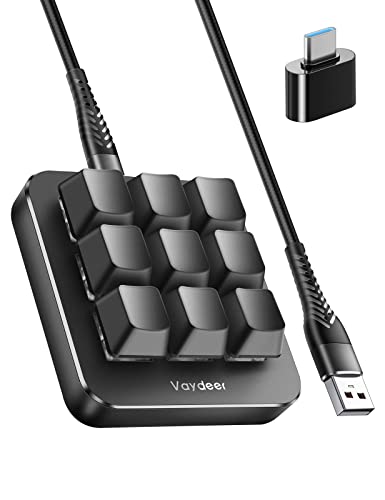
Vaydeer One-Handed Mechanical Keyboard Support NKRO, Hotkeys, One-Click Start,9 Fully Programmable Keys with Floating Window and Macro Multifunctional Keypad for iOS,Windows, Gift Idea for Him/Her
- Customizable Functional Layers: 6 layers for different scenes
- 9 NKRO Macro Keys: High-speed, conflict-free keys
- Floating Window Interface: Real-time key function display
As an affiliate, we earn on qualifying purchases.
As an affiliate, we earn on qualifying purchases.
Potential Developments and Community Exploration
Further testing and community experimentation are expected to explore the capabilities and limitations of using Emacs as a ‘Lispboard.’ Developers may develop more user-friendly tools or configurations to simplify the setup. There could also be discussions within the Emacs community about formalizing aspects of this concept or creating dedicated packages. Meanwhile, hardware makers might explore integrating programmable keyboards with Emacs scripting for enhanced customization. The next few months will likely show whether this remains a niche experiment or evolves into a broader trend among advanced users.
As an affiliate, we earn on qualifying purchases.
Key Questions
What is a ‘Lispboard’ in the context of Emacs?
A ‘Lispboard’ refers to a programmable keyboard setup that uses Emacs’s Lisp scripting capabilities to assign custom functions, macros, and shortcuts, effectively turning Emacs into a configurable input device.
Is this feature officially supported by Emacs?
No, this is an experimental demonstration by developers and not an official feature of the Emacs project. It showcases what is technically possible with current capabilities.
Can this setup be used for everyday programming tasks?
While technically feasible, the current implementation is complex and experimental, making it unlikely for widespread daily use without further development and user-friendly tools.
Will this influence future hardware or software development?
Potentially, as it highlights new ways to integrate software customization with hardware input devices, possibly inspiring future innovations in programmable keyboards and development environments.
What are the risks or limitations of using Emacs as a ‘Lispboard’?
Limitations include technical complexity, potential security concerns with custom scripts, hardware compatibility issues, and performance considerations that need further testing.
Source: hn