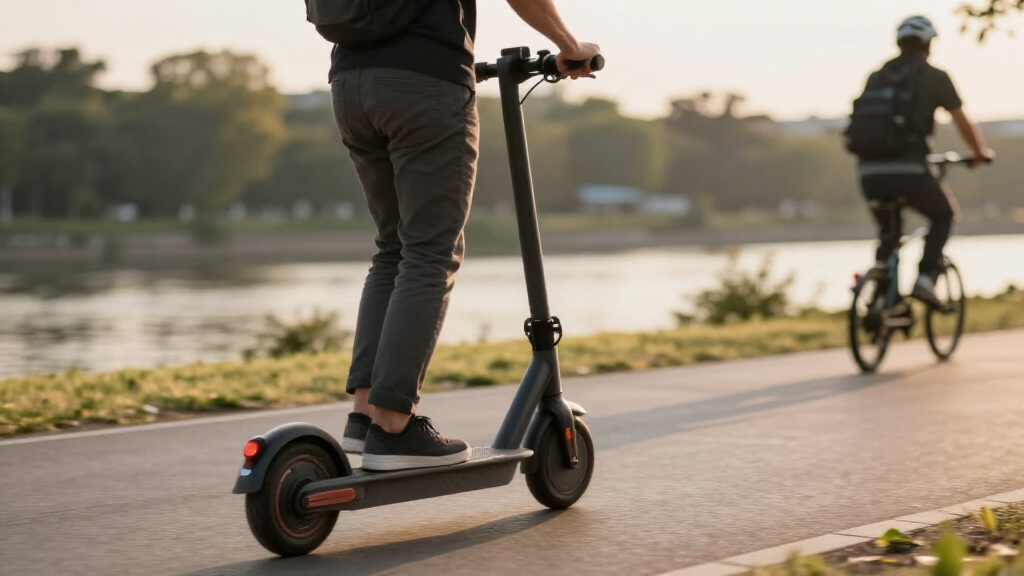

For most riders, I’d start with the NAVEE GT3 Pro: its stated 37.5-mile range and dual suspension make it the strongest comfort-and-distance pick in this lineup. The Hiboy S2 Pro stands out for its larger 10-inch solid tires and 500W motor, while the Segway Ninebot E2 Plus II is a simpler option for riders who want a familiar commuter-style scooter. The main tradeoffs are range versus portability, solid-tire convenience versus ride comfort, and higher power versus a heavier, more demanding ride. I compare all 14 models by intended use, listed specs, and practical compromises below. Read on for the full breakdown and help matching a scooter to your routes and priorities.

Get bike and ride gear delivered free with Prime
- Fast, free delivery on millions of items
- Prime Video, Amazon Music and more included
- Member-only deals all year
Key Takeaways
- NAVEE GT3 Pro leads for comfort and stated range: its 37.5-mile range and dual suspension distinguish it from the lineup’s mostly solid-tire commuter options.
- Hiboy S2 Pro offers a different kind of upgrade: a 500W motor and 10-inch solid tires make it a stronger fit for riders prioritizing tire size and motor output over the S2’s more basic setup.
- Solid tires are common but not universally comfortable: models such as the WERHY H5, MAXSHOT V1, and Hiboy S2 favor reduced puncture concerns, while suspension and larger tires matter more on rough routes.
- Powerful seated and high-speed scooters serve a narrower need: the 1600W seated model and 800W ECOROAD ES6 suit riders seeking a different format or more performance, but are less natural matches for lightweight, short-hop commuting.
- The lineup has several similar entry-level choices: compare the VOLPAM Q2’s stated 15-mile range with the Q1’s stated range of up to 28 miles, and check the exact HopCycle model before buying because the W3C, W3C/N3, and W3 MAX are distinct listings.
| Segway Ninebot E2 Plus II Electric Scooter |  | Best for Beginners | Battery capacity: 220Wh | Maximum range: Up to 16 miles in Eco Mode; 12 miles in Sport Mode | Maximum weight capacity: 198 pounds | VIEW LATEST PRICE | See Our Full Breakdown |
| WERHY H5 Electric Scooter, 350W Motor, 8.5-Inch Solid Tires |  | Best for App Features and Cruise Control | Motor power: 350W | Top speed: 19 MPH | Maximum range: Conflicting figures: up to 15 miles in description and 25 miles in specifications | VIEW LATEST PRICE | See Our Full Breakdown |
| NAVEE GT3 Pro Electric Scooter, 400W Motor, 37.5-Mile Range, Dual Suspension |  | Best for Long-Range Comfort | Motor power: 400W rated | Maximum speed: 19.9 MPH | Maximum range: Up to 37.5 miles | VIEW LATEST PRICE | See Our Full Breakdown |
| MAXSHOT V1 Electric Scooter for Adults, 350W Motor, 8.5-Inch Solid Tires, Up to 19 mph and 21-Mile Range |  | Best Lightweight Commuter | Motor power: 350W | Maximum speed: 19 mph | Maximum range: Up to 21 miles under specific conditions | VIEW LATEST PRICE | See Our Full Breakdown |
| Hiboy S2 Electric Scooter with 8.5-Inch Solid Tires |  | Best for App-Based Security | Motor power: 350W | Top speed: Up to 18 mph | Maximum range: Up to 17 miles under specific conditions | VIEW LATEST PRICE | See Our Full Breakdown |
| Gotrax GXL V2 Electric Scooter |  | Best for Low-Maintenance Short Trips | Motor: 250W | Battery: 36V, 5.2Ah | Maximum speed: 15.5 mph | VIEW LATEST PRICE | See Our Full Breakdown |
| Adult Electric Scooter with Seat, 1600W Motor, 25 MPH, 48V 15Ah Battery, Basket, and Foldable Frame |  | Best Seated Scooter for Errands | Motor: 1600W brushless | Top speed: 25 mph | Battery: 48V, 15Ah removable | VIEW LATEST PRICE | See Our Full Breakdown |
| ECOROAD ES6 Electric Scooter for Adults, 800W Motor (1000W Peak), 31 MPH |  | Best for Fast, Rough-Road Rides | Motor: 800W; 1000W peak | Maximum speed: 31 mph | Battery capacity: 624Wh | VIEW LATEST PRICE | See Our Full Breakdown |
| HopCycle W3C Foldable Electric Scooter for Adults |  | Best for Midrange Commuting | Motor: 500W | Battery: 36V, 7.8Ah | Maximum speed: 21 mph | VIEW LATEST PRICE | See Our Full Breakdown |
| HopCycle W3C/N3 Electric Scooter for Adults |  | Best Lightweight Pneumatic-Tire Commuter | Motor: 500W peak | Top speed: Up to 18 mph | Maximum range: Up to 21 miles | VIEW LATEST PRICE | See Our Full Breakdown |
| VOLPAM Q2 Electric Scooter, 350W Motor, 15-Mile Range, 19 MPH |  | Best for Low-Maintenance Commuting | Motor: 350W | Top speed: 19 mph | Maximum range: 15 miles | VIEW LATEST PRICE | See Our Full Breakdown |
| VOLPAM Q1 Electric Scooter, 350W Motor, Up to 28-Mile Range |  | Best for Longer-Range Solid-Tire Riding | Motor: 350W brushless | Top speed: 19 mph | Listed maximum range: Up to 28 miles; description also cites 15 miles | VIEW LATEST PRICE | See Our Full Breakdown |
| HopCycle W3 MAX Electric Scooter for Adults |  | Best for Speed and Rougher Pavement | Motor: 1000W | Top speed: 25 mph | Range: 22–28 miles per charge | VIEW LATEST PRICE | See Our Full Breakdown |
| Hiboy S2 Pro Electric Scooter, 500W Motor, 10-Inch Solid Tires |  | Best for Suspension with Solid Tires | Motor: 500W brushless hub motor | Maximum speed: 19 mph | Maximum range: 25.6 miles under specific conditions | VIEW LATEST PRICE | See Our Full Breakdown |
| electric kick scooter | Brakes | Weight | Motor | Maximum range |
|---|---|---|---|---|
| Segway Ninebot E2 Plus II Elec | Front electric brake and rear drum brake | — | — | Up to 16 miles in Eco Mode; 12 miles in Sport Mode |
| WERHY H5 Electric Scooter | — | Not specified | — | Conflicting figures: up to 15 miles in description and 25 miles in specifications |
| NAVEE GT3 Pro Electric Scooter | — | 46 pounds and 48.5 pounds are both listed | — | Up to 37.5 miles |
| MAXSHOT V1 Electric Scooter fo | Drum brake and EABS anti-lock braking | 31 pounds | — | Up to 21 miles under specific conditions |
| Hiboy S2 Electric Scooter with | Disc and eABS regenerative braking | 35.5 pounds | — | Up to 17 miles under specific conditions |
| Gotrax GXL V2 Electric Scooter | — | 27 pounds | 250W | — |
| Adult Electric Scooter with Se | Front and rear disc | — | 1600W brushless | — |
| ECOROAD ES6 Electric Scooter f | Front and rear disc with EABS | 55.9 pounds | 800W; 1000W peak | — |
| HopCycle W3C Foldable Electric | — | 31.5 pounds | 500W | — |
| HopCycle W3C/N3 Electric Scoot | Electronic and rear drum | 28.4 pounds | 500W peak | Up to 21 miles |
| VOLPAM Q2 Electric Scooter | Electronic brake and drum brake | 30 lbs | 350W | 15 miles |
| VOLPAM Q1 Electric Scooter | Dual braking system | — | 350W brushless | — |
| HopCycle W3 MAX Electric Scoot | Front drum and rear disc | — | 1000W | — |
| Hiboy S2 Pro Electric Scooter | Disc brake and EABS regenerative anti-lock braking | 35.9 lbs | 500W brushless hub motor | 25.6 miles under specific conditions |
More Details on Our Top Picks
Segway Ninebot E2 Plus II Electric Scooter
I’d put the Segway Ninebot E2 Plus II near the top for newer riders who want a straightforward commuter rather than a long-range machine. Its stated 16-mile Eco Mode range is more modest than the NAVEE GT3 Pro’s 37.5-mile claim, but that smaller battery helps keep the scooter lighter than the NAVEE at 48.5 pounds. Front suspension and hollow shock-absorbing tires add some comfort on imperfect pavement, while the front electric and rear drum brakes provide two braking methods. The 198-pound rider limit is lower than the 265-pound limits listed for the NAVEE GT3 Pro and MAXSHOT V1, so I’d check that fit before choosing it. At 36.2 pounds, it still isn’t an effortless carry, and its roughly 7.5-hour charge calls for overnight planning.
Pros:- Front suspension and shock-absorbing tires help soften uneven pavement.
- Dual braking combines a front electric brake with a rear drum brake.
- Foldable design and a stated Eco Mode range of up to 16 miles suit shorter commutes.
- UL 2272 and UL 2271 certifications are listed.
Cons:- The 198-pound maximum rider weight is below the 265-pound limits listed for the NAVEE GT3 Pro and MAXSHOT V1.
- At 36.2 pounds, it may be cumbersome to carry for frequent stair climbs.
- A full charge takes approximately 7.5 hours.
Best for: Newer adult riders seeking a foldable short-commute scooter with front suspension and a clearly stated Eco Mode range, who weigh no more than 198 pounds.
Not ideal for: Heavier riders, people who need extended range, or commuters who must carry a scooter up stairs regularly; its rider limit is 198 pounds and it weighs 36.2 pounds.
- Battery capacity:220Wh
- Maximum range:Up to 16 miles in Eco Mode; 12 miles in Sport Mode
- Maximum weight capacity:198 pounds
- Item weight:36.2 pounds
- Wheel size:8.1 inches
- Charging time:Approximately 7.5 hours
- Brakes:Front electric brake and rear drum brake
- Suspension:Front suspension
- Certifications:UL 2272 and UL 2271
Our verdict“Choose the E2 Plus II for a beginner-friendly, shorter-range commute with some front-end cushioning, but skip it if you need a higher rider limit or longer range.”
WERHY H5 Electric Scooter, 350W Motor, 8.5-Inch Solid Tires
The WERHY H5 suits riders who value app controls and cruise control more than a cushioned ride. Its 350W motor and stated top speed of 19 MPH put it in similar speed territory to the MAXSHOT V1, while solid tires avoid inflation and puncture maintenance. That convenience has a cost: the H5 has no suspension, unlike the MAXSHOT V1’s dual suspension or the NAVEE GT3 Pro’s dual suspension and pneumatic tires. Range figures also conflict: the description says up to 15 miles, while the specifications list 25 miles, so I wouldn’t plan a commute around the longer figure without clarification. A four-hour charge is shorter than the Segway E2 Plus II’s roughly 7.5 hours, but the H5’s weight is not specified, which makes its portability harder to judge.
Pros:- Solid 8.5-inch tires avoid inflation and reduce puncture-related upkeep.
- App controls include riding modes, cruise control, and battery monitoring.
- Dual braking combines drum brakes with EABS regenerative anti-lock braking.
- Four-hour charge time is shorter than the Segway Ninebot E2 Plus II’s stated charging time.
Cons:- No suspension, unlike the MAXSHOT V1 and NAVEE GT3 Pro.
- The description’s 15-mile range conflicts with the 25-mile figure in the specifications.
- Product weight is not specified, making portability difficult to compare.
Best for: Urban riders who want solid tires, app-based ride controls, cruise control, and a relatively quick stated charge time for shorter trips.
Not ideal for: Riders who travel over rough pavement, need a dependable range estimate, or want to compare carry weight before buying; suspension is absent, range figures conflict, and weight is unspecified.
- Motor power:350W
- Top speed:19 MPH
- Maximum range:Conflicting figures: up to 15 miles in description and 25 miles in specifications
- Wheel size:8.5 inches
- Tire type:Solid
- Maximum weight capacity:265 pounds
- Battery charge time:4 hours
- Braking system:Drum brakes and EABS regenerative anti-lock braking
- Weight:Not specified
Our verdict“Pick the H5 for app controls and low-maintenance solid tires on smoother routes, but look elsewhere if ride cushioning or a consistent range estimate matters.”
NAVEE GT3 Pro Electric Scooter, 400W Motor, 37.5-Mile Range, Dual Suspension
I’d choose the NAVEE GT3 Pro when range and ride comfort matter more than easy carrying. Its stated 37.5-mile maximum range is far beyond the shorter commute claims for the Segway Ninebot E2 Plus II and Hiboy S2, while 10-inch pneumatic tires and dual suspension are better suited to rougher routes than their smaller solid-tire setups. The tradeoff is substantial bulk: it weighs 48.5 pounds, compared with 31 pounds for the MAXSHOT V1, so carrying it regularly is a tougher proposition. It also takes up to eight hours to charge. App controls and Apple Find My integration add useful tracking and management features, but product details conflict on weight, listing both 46 and 48.5 pounds. I’d treat the range as a maximum claim, not a guaranteed everyday distance.
Pros:- Stated maximum range of up to 37.5 miles exceeds the shorter-range claims for the Segway E2 Plus II and Hiboy S2.
- Dual suspension and 10-inch pneumatic tires are suited to more comfort-focused riding.
- Apple Find My integration and app controls add connected features.
- One-step folding design supports storage and transport by vehicle.
Cons:- At 48.5 pounds in the listed specification, it is much heavier than the 31-pound MAXSHOT V1.
- Charging takes up to eight hours.
- Product details conflict, listing weights of both 46 and 48.5 pounds.
Best for: Long-distance commuters who want pneumatic tires, dual suspension, app connectivity, and Apple Find My, and who can store or transport a heavier scooter.
Not ideal for: Riders who regularly carry their scooter upstairs, need a shorter charging cycle, or require a clear confirmed weight before purchase.
- Motor power:400W rated
- Maximum speed:19.9 MPH
- Maximum range:Up to 37.5 miles
- Battery capacity:10.2 Ah
- Weight:46 pounds and 48.5 pounds are both listed
- Weight capacity:265 pounds
- Wheel size:10 inches
- Suspension:Dual suspension
- Charging time:Up to 8 hours
Our verdict“Choose the NAVEE GT3 Pro for claimed long range and a cushioned ride, but not if you need a lightweight scooter or a quick recharge.”
MAXSHOT V1 Electric Scooter for Adults, 350W Motor, 8.5-Inch Solid Tires, Up to 19 mph and 21-Mile Range
The MAXSHOT V1 is my strongest fit here for commuters who need a scooter that is easier to carry without giving up basic comfort features. At 31 pounds, it is lighter than the Segway Ninebot E2 Plus II at 36.2 pounds and far lighter than the NAVEE GT3 Pro at 48.5 pounds. Its dual suspension is a useful distinction from the WERHY H5, which also has solid tires but no suspension. The V1 pairs those features with an 8.5-inch solid honeycomb tire setup, a drum brake and EABS, and a stated range of up to 21 miles. That range depends on conditions, so I wouldn’t treat it as a fixed daily distance. A four-hour charge is convenient, but the scooter does not include a lock, which adds a separate security task for riders who park outside.
Pros:- At 31 pounds, it is lighter than the Segway Ninebot E2 Plus II and NAVEE GT3 Pro.
- Dual suspension adds cushioning despite the solid honeycomb tires.
- Dual braking uses a drum brake and EABS anti-lock braking.
- Four-hour charge time and foldable aluminum frame suit regular commuting.
Cons:- The stated 21-mile range depends on riding conditions.
- A lock is not included.
- Solid tires do not provide the same road feel as the NAVEE GT3 Pro’s pneumatic tires.
Best for: Commuters who need a foldable scooter that is comparatively easy to carry and want solid tires, dual suspension, and a 265-pound capacity.
Not ideal for: Riders seeking pneumatic tires, a guaranteed 21-mile trip, or a ready-to-use locking solution; the range is conditional and a lock is not included.
- Motor power:350W
- Maximum speed:19 mph
- Maximum range:Up to 21 miles under specific conditions
- Weight:31 pounds
- Weight capacity:265 pounds
- Tire size and type:8.5-inch solid honeycomb
- Suspension:Dual suspension
- Brakes:Drum brake and EABS anti-lock braking
- Battery charge time:4 hours
Our verdict“Choose the MAXSHOT V1 if carrying weight and commuting practicality matter more than pneumatic tires or a guaranteed range.”
Hiboy S2 Electric Scooter with 8.5-Inch Solid Tires
The Hiboy S2 makes the most sense for riders who value app-based locking and ride records in a practical, shorter-range scooter. Its 350W motor reaches up to 18 mph, just below the 19 mph listed for the MAXSHOT V1 and WERHY H5. Rear suspension gives it a comfort feature missing from the H5, though it lacks the MAXSHOT’s dual suspension and the NAVEE GT3 Pro’s larger pneumatic tires. Solid rubber tires avoid routine inflation, but they can feel less forgiving than pneumatic options on broken pavement. Hiboy lists up to 17 miles of range under specific conditions and a five-hour charge, placing it below the NAVEE for claimed distance and behind the MAXSHOT for charging speed. The optional seat is not included, so I’d treat this as a standing scooter rather than a seated setup.
Pros:- App supports scooter locking and ride statistics on iOS and Android.
- Rear suspension offers some cushioning, unlike the WERHY H5, which has no suspension.
- Solid rubber tires avoid inflation and puncture-related upkeep.
- Front and rear lighting and a dual disc and regenerative braking system add commuting features.
Cons:- The stated range of up to 17 miles depends on specific conditions and is shorter than the NAVEE GT3 Pro’s maximum claim.
- Rear suspension is less extensive than the MAXSHOT V1’s dual suspension.
- The optional seat is not included.
Best for: Commuters who want a foldable solid-tire scooter with rear suspension, front and rear lights, and app-based locking and ride statistics.
Not ideal for: Riders who need longer claimed range, dual suspension, or a seat included in the package; its range is conditional and the seat is optional.
- Motor power:350W
- Top speed:Up to 18 mph
- Maximum range:Up to 17 miles under specific conditions
- Tire size and type:8.5-inch solid rubber
- Weight:35.5 pounds
- Weight capacity:220 pounds
- Battery charge time:5 hours
- Brakes:Disc and eABS regenerative braking
- Suspension:Rear suspension
Our verdict“Choose the Hiboy S2 for app-based locking and a practical feature set on shorter commutes, but look elsewhere for longer range or dual suspension.”
Gotrax GXL V2 Electric Scooter
I’d pick the Gotrax GXL V2 for short, predictable trips where avoiding tire upkeep matters more than maximizing comfort or distance. Its solid honeycomb tires resist punctures and need no inflation, while the 27-pound frame folds for storage or occasional carrying. The 250W motor and claimed 12-mile maximum range put it on the modest end of this group: the HopCycle W3C offers a higher stated top speed and longer range, while the GXL V2 keeps its appeal in simpler upkeep. Front suspension may soften some bumps, but it cannot match the cushioning of air-filled tires. I’d also treat the range as a best-case figure and plan shorter outings. Rear braking and a 220-pound capacity make this a straightforward commuter, not a high-performance or heavy-load choice.
Pros:- Solid honeycomb tires resist punctures and require no inflation.
- Folds down and weighs 27 pounds for easier storage and occasional carrying.
- Front suspension, cruise control, and a headlight add useful commuting features.
- Kick-to-start helps reduce accidental acceleration while mounting.
Cons:- The 12-mile range is a claimed maximum under optimum conditions, limiting its fit for longer commutes.
- Solid tires provide less cushioning than the pneumatic tires on the HopCycle W3C/N3.
- Rear braking only and a 220-pound capacity are less suited to demanding rides or heavier riders.
Best for: Riders making short city trips who want puncture-resistant tires, a folding frame, and simple routine upkeep.
Not ideal for: Long-distance commuters, riders who regularly cross rough pavement, or buyers needing more than a 220-pound capacity.
- Motor:250W
- Battery:36V, 5.2Ah
- Maximum speed:15.5 mph
- Claimed maximum range:12 miles under optimum conditions
- Tires:8.5-inch solid honeycomb
- Weight:27 pounds
- Maximum weight capacity:220 pounds
- Charge time:4 hours
Our verdict“Choose the GXL V2 for short, low-maintenance rides, but pick a longer-range model for daily distance or more cushioning.”
Adult Electric Scooter with Seat, 1600W Motor, 25 MPH, 48V 15Ah Battery, Basket, and Foldable Frame
This seated scooter is the lineup’s most errand-focused option: a cushioned seat, removable rear basket, and removable battery make it better suited to carrying everyday items than the stand-up HopCycle W3C. Its dual suspension, 10-inch all-terrain tires, and front and rear disc brakes also point toward a more substantial ride than a compact commuter. The claimed range reaches 45 miles, but the product information conflicts with itself, listing up to 70 miles elsewhere; I would not plan a route around either maximum without clarification. Capacity claims conflict too: the description says 305 pounds while specifications say 365. Those inconsistencies make this a harder choice for buyers who need dependable range or load limits. Its bulk and seated layout favor practical trips over easy carry-and-go commuting.
Pros:- Cushioned seat and removable basket support practical errands.
- Removable 48V 15Ah battery can be charged separately from the scooter.
- Dual suspension and 10-inch all-terrain tires suit less-smooth routes.
- Front and rear disc brakes provide braking at both ends.
Cons:- Range claims conflict: the description says up to 45 miles while specifications list 70 miles.
- Weight-capacity information conflicts between 305 and 365 pounds.
- The seated, basket-equipped design is less convenient to carry than the stand-up HopCycle W3C.
Best for: Riders who want a seated scooter for errands and value a basket, removable battery, and suspension over a lightweight carry.
Not ideal for: Commuters who need a clearly documented load limit or range, or anyone who must regularly carry a scooter upstairs.
- Motor:1600W brushless
- Top speed:25 mph
- Battery:48V, 15Ah removable
- Claimed range:Up to 45 miles in description; specifications also state 70 miles
- Tires:10 × 3-inch all-terrain
- Suspension:Dual
- Brakes:Front and rear disc
- Weight capacity:Conflicting claims: 305 pounds in description; 365 pounds in specifications
- Charging time:6–8 hours
Our verdict“Pick this model for seated local errands if you can confirm the range and load limit before relying on them.”
ECOROAD ES6 Electric Scooter for Adults, 800W Motor (1000W Peak), 31 MPH
The ECOROAD ES6 is the performance pick here, with a claimed 31 mph top speed, an 800W motor with 1000W peak output, and 10-inch tubeless off-road tires. Dual suspension and disc brakes with EABS give it a more rough-road-oriented setup than the lighter HopCycle W3C, whose stated speed tops out at 21 mph. The ES6 also lists app control, cruise control, and a color display, plus a helmet, storage bag, and U-lock. The tradeoff is substantial: at 55.9 pounds, it is far less appealing for commuters who carry a scooter onto transit or upstairs. Its 40-mile range is a claim, not a guaranteed trip distance, and the listed 180-day warranty is shorter than the seated scooter’s three-year term.
Pros:- 800W motor with 1000W peak output and a claimed top speed of 31 mph.
- 10-inch tubeless off-road tires and dual suspension suit uneven surfaces.
- Dual disc brakes with EABS, app controls, cruise control, and a color display.
- Helmet, storage bag, and U-lock are listed as included.
Cons:- At 55.9 pounds, it is considerably harder to carry than the 31.5-pound HopCycle W3C.
- The listed 180-day warranty is short compared with the seated scooter’s three-year warranty.
- The claimed 40-mile range can vary with conditions and should not be treated as a guaranteed distance.
Best for: Experienced riders seeking higher claimed speed, suspension, and tubeless tires for longer or rougher rides.
Not ideal for: Transit commuters and apartment dwellers who need a scooter light enough to carry regularly, or buyers prioritizing a longer warranty.
- Motor:800W; 1000W peak
- Maximum speed:31 mph
- Battery capacity:624Wh
- Claimed maximum range:Up to 40 miles
- Tires:10-inch tubeless off-road
- Brakes:Front and rear disc with EABS
- Maximum load:330 pounds
- Weight:55.9 pounds
- Charge time:6 hours
Our verdict“Choose the ES6 for speed and rough-road equipment if its 55.9-pound weight and short listed warranty suit your priorities.”
HopCycle W3C Foldable Electric Scooter for Adults
The HopCycle W3C offers a middle ground for riders who want more pace than the Gotrax GXL V2 without stepping up to the ECOROAD ES6’s claimed 31 mph speed and 55.9-pound heft. Its 500W motor is paired with a stated 21 mph maximum and a 15–21-mile range, making it a more plausible fit for ordinary commutes than the Gotrax’s 12-mile maximum claim. A folding frame helps with storage, while app connectivity, cruise control, a digital display, and dual braking add convenience without the ES6’s off-road emphasis. At 31.5 pounds, though, it is not effortless to carry, and its stated range varies with riding conditions. I’d also note the 180-day warranty when comparing it with options that list longer coverage.
Pros:- 500W motor and 21 mph stated maximum speed outpace the Gotrax GXL V2.
- Foldable design supports storage at home or work.
- App connection, cruise control, and digital display provide useful ride controls.
- Dual braking system adds braking options.
Cons:- The 15–21-mile stated range varies with riding conditions.
- At 31.5 pounds, it is heavier to carry than the Gotrax GXL V2.
- The 180-day warranty is limited.
Best for: Commuters who want a foldable stand-up scooter with a moderate speed and a stated range beyond the Gotrax GXL V2.
Not ideal for: Riders facing rough terrain, those who need a scooter for frequent long-distance trips, or anyone seeking a lightweight carry.
- Motor:500W
- Battery:36V, 7.8Ah
- Maximum speed:21 mph
- Stated range:15–21 miles
- Weight:31.5 pounds
- Weight capacity:264 pounds
- Wheel size:8.5 inches
- Warranty:180 days
Our verdict“Choose the W3C for a moderate-speed folding commute, but look elsewhere for easy carrying or a clearly dependable long range.”
HopCycle W3C/N3 Electric Scooter for Adults
Among the two HopCycle options, the W3C/N3 is the easier one to carry: it weighs 28.4 pounds, compared with the W3C’s 31.5 pounds, and its 8.5-inch pneumatic tires offer more cushioning than the Gotrax GXL V2’s solid tires. The 500W peak motor, folding frame, app controls, electronic lock, and cruise control suit everyday short-to-medium commuting. Its stated maximum is 18 mph, below the W3C’s 21 mph, and the product text gives inconsistent speed and range details, so I would avoid choosing it for a tight schedule based on the maximum claims. The water-resistance rating also conflicts between IP65 and IPX4. Those ambiguities temper an otherwise practical package, especially for riders who expect to use it in wet conditions.
Pros:- At 28.4 pounds, it is lighter than the HopCycle W3C and ECOROAD ES6.
- Pneumatic tires provide more cushioning than the Gotrax GXL V2’s solid tires.
- App includes electronic lock, riding modes, and cruise control.
- Folding frame and a four-hour listed charge time support routine commuting.
Cons:- Product text gives inconsistent speed and range information.
- Water-resistance claims conflict between IP65 and IPX4.
- The 180-day warranty is limited.
Best for: Commuters who need a relatively light folding scooter and prefer air-filled tires for a more cushioned ride.
Not ideal for: Riders who need a verified water-resistance rating, predictable range figures, or the higher stated speed of the HopCycle W3C.
- Motor:500W peak
- Top speed:Up to 18 mph
- Maximum range:Up to 21 miles
- Battery:36V, 7.8Ah
- Tires:8.5-inch pneumatic
- Brakes:Electronic and rear drum
- Weight:28.4 pounds
- Maximum weight capacity:264 pounds
- Charge time:4 hours
Our verdict“Pick the W3C/N3 for a lighter, cushioned commuter if you can live with unclear speed, range, and water-resistance claims.”
VOLPAM Q2 Electric Scooter, 350W Motor, 15-Mile Range, 19 MPH
I’d choose the VOLPAM Q2 for short, regular trips where avoiding tire upkeep matters more than maximizing comfort or distance. Its solid honeycomb tires resist punctures, and the electronic and drum brakes give riders two braking mechanisms. At 30 pounds, it can be folded and carried, though it is not especially light. The stated 15-mile range is more limited than the VOLPAM Q1’s claimed maximum of 28 miles, so I’d favor the Q2 for shorter commutes rather than longer outings. Its 19 mph top speed, lights, app controls, and cruise control cover useful everyday needs, while the roughly four-hour charge time helps keep downtime manageable. The tradeoff is a firmer ride than a scooter with pneumatic tires, particularly on rough pavement.
Pros:- Solid honeycomb tires are designed to resist punctures and avoid inflation upkeep.
- Electronic and drum brakes provide two braking mechanisms.
- Front and rear lights, app controls, and cruise control add everyday commuting features.
- Approximately four-hour charging time helps limit time off the road.
Cons:- The stated maximum range of 15 miles is shorter than the VOLPAM Q1’s listed maximum.
- Solid tires can transmit more bumps than pneumatic tires.
- At 30 pounds, it may feel heavy to carry for extended distances.
Best for: Commuters with short, predictable routes who want puncture-resistant tires, app features, and a relatively quick recharge.
Not ideal for: Riders with longer daily routes or rough pavement, since its stated range is 15 miles and solid tires offer less cushioning.
- Motor:350W
- Top speed:19 mph
- Maximum range:15 miles
- Maximum load:265 lbs
- Tires:8.5-inch solid honeycomb
- Brakes:Electronic brake and drum brake
- Weight:30 lbs
- Charge time:About 4 hours
- Features:Foldable, app control, LCD display, and cruise control
Our verdict“Choose the Q2 for shorter commutes where low tire maintenance and a quick recharge matter more than range or ride cushioning.”
VOLPAM Q1 Electric Scooter, 350W Motor, Up to 28-Mile Range
The VOLPAM Q1 is the range-focused choice among these two VOLPAM scooters: its listing gives a maximum of 28 miles, compared with the Q2’s 15 miles. That makes it the more appealing option for riders who want fewer charging stops, while retaining a 350W motor, 19 mph top speed, foldable frame, and solid tires. The tires avoid inflation and punctures, but neither VOLPAM model offers the cushioning of the HopCycle W3 MAX’s pneumatic tires and rear suspension. I’d be cautious about planning a route around the Q1’s headline range, since its product description also mentions a conflicting 15-mile figure. App controls for riding data, speed modes, and locking are useful, but the uncertainty around distance is a real drawback for commute planning.
Pros:- Lists a maximum range of up to 28 miles, more than the Q2’s stated 15 miles.
- Solid honeycomb tires need no inflation and resist punctures.
- Foldable design and app controls support routine commuting and scooter locking.
- Dual brakes and front and rear lights add practical safety features.
Cons:- The listing gives conflicting range figures, including both 15 miles and a maximum of 28 miles.
- Solid tires provide less cushioning than the HopCycle W3 MAX’s pneumatic tires and rear suspension.
- The listed 28-mile maximum should not be treated as a guaranteed real-world distance.
Best for: Riders seeking a foldable solid-tire scooter for moderate commutes who value a potentially longer range and app-based controls.
Not ideal for: Anyone who needs a dependable range estimate for a long daily route, or prefers a cushioned ride on uneven roads.
- Motor:350W brushless
- Top speed:19 mph
- Listed maximum range:Up to 28 miles; description also cites 15 miles
- Weight capacity:264 lbs
- Tires:8.5-inch solid honeycomb
- Brakes:Dual braking system
- Lights:Front headlight and rear warning light
- Controls:Smartphone app
- Warranty:One year
Our verdict“Pick the Q1 over the Q2 if you want the longer listed range, but avoid relying on its maximum figure until the conflicting range claims are clarified.”
HopCycle W3 MAX Electric Scooter for Adults
Among these four, the HopCycle W3 MAX makes the strongest case for riders who want more speed and a more forgiving ride. Its 1000W motor and 25 mph top speed outpace the 19 mph VOLPAM Q1 and Hiboy S2 Pro, while 10-inch pneumatic tires and rear spring suspension offer cushioning that their solid tires cannot match. A stated 22–28-mile range also gives it more distance potential than the Q2, though the listing notes that range and configuration details vary. It folds and weighs a claimed 28.2 pounds, lighter than the 35.9-pound Hiboy, but its 180-day warranty is shorter than the one-year coverage listed for the other three. The faster performance and bump absorption come with more range uncertainty and less warranty coverage.
Pros:- 1000W motor and 25 mph top speed exceed the 19 mph limits listed for the VOLPAM Q1 and Hiboy S2 Pro.
- 10-inch pneumatic tires and rear spring suspension help soften bumps.
- Front drum and rear disc brakes provide two braking types.
- Claimed 28.2-pound weight and foldable design aid carrying and storage.
Cons:- The 180-day warranty is shorter than the one-year warranty listed for the VOLPAM models and Hiboy S2 Pro.
- The product listing says range and configuration details vary, making planning less certain.
- Its 25 mph top speed may be more than riders seeking a relaxed, lower-speed commute need.
Best for: Commuters who want a faster scooter with pneumatic tires and rear suspension for routes that include uneven pavement.
Not ideal for: Buyers who prioritize a longer warranty, predictable range claims, or a slower, simpler commuter scooter.
- Motor:1000W
- Top speed:25 mph
- Range:22–28 miles per charge
- Battery:36V 15Ah
- Tires:10-inch pneumatic
- Suspension:Rear spring suspension
- Brakes:Front drum and rear disc
- Weight and maximum load:28.2 lbs; 264 lbs
- Warranty:180 days
Our verdict“Choose the W3 MAX for higher speed and better bump absorption, provided its shorter warranty and variable range details suit your needs.”
Hiboy S2 Pro Electric Scooter, 500W Motor, 10-Inch Solid Tires
The Hiboy S2 Pro suits riders who want some help smoothing bumps without taking on pneumatic-tire upkeep. Its 10-inch solid tires pair with rear dual shock absorbers, a setup that distinguishes it from the smaller 8.5-inch solid-tire VOLPAM Q2, though it still won’t cushion as naturally as the HopCycle W3 MAX’s air-filled tires. The 500W motor and 19 mph top speed make it a more powerful alternative to the 350W VOLPAM models, and the listed 25.6-mile maximum range may cover longer trips under specific conditions. That range is not a guaranteed everyday figure. The tradeoffs are weight—35.9 pounds is the heaviest of these four—and an eight-hour charge time, considerably longer than the Q2’s approximately four hours.
Pros:- Rear dual shock absorbers add cushioning alongside the puncture-resistant solid tires.
- 500W motor is more powerful than the 350W motors listed for the VOLPAM Q1 and Q2.
- App supports scooter locking and adjustments to acceleration and braking.
- Disc and EABS regenerative anti-lock braking provide two braking functions.
Cons:- At 35.9 pounds, it is heavier than the other three scooters in this batch.
- Eight-hour charging time is twice the Q2’s approximately four-hour estimate.
- The 25.6-mile maximum range is stated under specific conditions, not as a guaranteed everyday range.
Best for: Riders who want a solid-tire scooter with rear suspension, app-based locking, and a listed range suited to longer trips under favorable conditions.
Not ideal for: People who need to carry a scooter often, want a short charging window, or ride mainly over rough surfaces where pneumatic tires may feel more forgiving.
- Motor:500W brushless hub motor
- Maximum speed:19 mph
- Maximum range:25.6 miles under specific conditions
- Battery:36V, 11.6Ah
- Maximum load:220 lbs
- Tires and suspension:10-inch solid tires; rear dual shock absorbers
- Brakes:Disc brake and EABS regenerative anti-lock braking
- Weight:35.9 lbs
- Charge time:8 hours
Our verdict“Pick the S2 Pro if you want rear suspension with solid tires and can accept a heavier scooter and longer charging time.”

How We Picked
I compared the scooters by the needs that most often shape a kick-scooter purchase: usable range, motor output, tire and suspension setup, portability, ride format, and the practical value of each feature. I treated listed range and speed as manufacturer claims, not guarantees; rider weight, terrain, temperature, and riding style can change real-world results. I also separated kick scooters from options whose seat, basket, or high power shifts them toward a different kind of ride.
The ranking favors models with a clearer fit across everyday routes and a useful balance of comfort, capability, and convenience. The NAVEE GT3 Pro ranks first for its stated range and dual suspension, while the Hiboy S2 Pro earns a strong position for its larger solid tires and higher motor rating. More basic solid-tire models remain relevant for simple trips, but their lower stated range or less comfort-focused setup keeps them below the more versatile picks. Where product names provide limited specifications, I avoid assuming features that are not stated and recommend checking the exact listing details before choosing.
Factors to Consider When Choosing Best Electric Kick Scooters
Specs help narrow the field, but a scooter has to fit the route, storage situation, and rider—not just look strong on paper. I’d settle those practical questions before treating claimed range or motor power as deciding factors.
Match Claimed Range to Your Real Route
Manufacturer range figures are best treated as upper-end reference points, not a promise for every trip. Hills, frequent stops, cold weather, rider weight, and higher speeds can all reduce distance per charge. I’d estimate the full round trip, add room for detours and battery aging, and favor a scooter with more stated range than the minimum route requires. That buffer matters most when charging at work or school is uncertain. A shorter-range model can still make sense for predictable local trips if it is easier to store or carry. Avoid choosing solely by the largest range number without checking how the scooter’s weight and ride comfort fit your routine.
Choose Tires and Suspension for Your Pavement
Solid tires reduce the chance of a puncture, a useful tradeoff for riders who want less tire upkeep. They can also transmit more vibration over cracked pavement, so a puncture-resistant setup is not automatically the most comfortable one. Suspension, larger tires, and a wider deck can soften rough stretches, but those features may add bulk and maintenance needs. For smooth sidewalks and short trips, simplicity may matter more than cushioning. For uneven streets or longer rides, comfort can affect how often you actually use the scooter. Check tire type and suspension together rather than treating either spec as a complete comfort measure.
Don’t Treat Motor Wattage as a Complete Performance Score
Motor ratings offer a clue about a scooter’s intended capability, but wattage alone cannot tell you how it will climb hills or accelerate under your weight. Peak and continuous ratings may be described differently across listings, making direct comparisons tricky. Think about the steepest regular incline on your route, how often you carry a bag, and whether you need to keep pace with traffic or simply travel on paths. Higher output can bring more demanding handling and a heavier scooter, so it may be unnecessary for flat, short commutes. Check local speed rules before choosing a model advertised for higher speeds. A well-matched moderate-power scooter can be more useful than an oversized one you rarely ride at its full capability.
Count Every Carry and Storage Point
A scooter that folds may still be awkward to lift onto transit, up stairs, or into a car trunk. Check the listed weight, folded dimensions, and how the folded scooter is carried—not just whether it folds. Measure the space where it will live, including room to maneuver through doorways or past furniture. If you must carry it regularly, prioritize manageable weight over a longer range you seldom need. A seat and basket can help with specific errands but change the storage footprint and ride style. Buyers who leave a scooter outdoors should also check the maker’s guidance for weather exposure and storage.
Budget for Maintenance, Safety, and Replacement Parts
The purchase decision includes more than motor and battery specs: brakes, lights, reflectors, and a stable riding position matter on everyday routes. Confirm that the listing identifies the braking system and that replacement tires, brake parts, and chargers are available for the exact model. Solid tires can reduce puncture repairs, while other parts may still require adjustment or replacement over time. A helmet and appropriate visibility gear should be part of the ownership plan, not an afterthought. Read the warranty terms and service process before buying, especially for less familiar model names. If a listing leaves key safety or support details unclear, contact the seller or choose a better-documented option.
Frequently Asked Questions
Should I choose a solid-tire scooter or one with suspension?
I’d base this on pavement quality and how long you expect to ride at a time. Solid tires help avoid punctures, but can feel harsh on broken pavement; suspension can reduce vibration without removing every bump. In this lineup, the WERHY H5, MAXSHOT V1, and Hiboy S2 use solid tires, while the NAVEE GT3 Pro pairs suspension with a longer stated range. If your regular route is smooth, tire convenience may matter more than extra cushioning. For rough streets or longer trips, prioritize the complete ride setup rather than tire type alone.
How much more range should I plan for than my usual round trip?
I’d leave a meaningful buffer rather than plan to arrive with the battery nearly depleted. Advertised range can fall with hills, cold weather, frequent acceleration, heavier loads, and battery wear. Consider the longest trip you might make, not just your average day, and include possible detours. If charging is available at your destination, a lower-range scooter may still work, but confirm that you can charge it safely and conveniently. This is why the NAVEE GT3 Pro’s stated range stands out, though it still should not be treated as a guaranteed real-world distance.
Is a higher-wattage scooter automatically better for hills?
No. Motor wattage is only one part of hill performance; the rating convention, rider load, slope, battery condition, and speed all play a part. Ask the manufacturer for hill-climbing guidance for your expected rider weight and route rather than comparing wattage alone. The ECOROAD ES6 and seated 1600W model advertise substantially more power than the 350W options, but that does not make them the best fit for every rider. Higher power may come with extra weight, faster acceleration, or a ride format you do not need. For a hilly commute, verify climbing performance and braking capacity together.
What should I check when several listings have similar scooter names?
Confirm the exact model designation, included components, motor rating, range claim, tire type, and warranty before placing an order. This matters here because the lineup includes HopCycle W3C, W3C/N3, and W3 MAX listings that should not be assumed to share the same specifications. Product titles can also combine peak output, speed, and range claims without clarifying how they were measured. Save a copy of the listing details and check that the delivered model matches them. If a key spec is missing or inconsistent, ask the seller to clarify rather than relying on a name that looks similar.
Is a scooter with a seat a good choice for a daily commute?
It can be a good fit if you specifically want a seated ride and have space for a larger scooter, but it is not a direct substitute for a compact kick scooter. The seated 1600W model also lists a basket and foldable frame, features that may help with errands while adding size and complexity. Check its folded dimensions, total weight, braking details, and local rules before choosing it for public routes. Riders who need to carry a scooter onto transit or upstairs may prefer a conventional standing model. Decide based on the whole route and storage routine, not the seat alone.
Conclusion
For the broadest mix of stated range and ride comfort, I’d choose the NAVEE GT3 Pro as the best overall pick. The best premium-leaning choice is also the NAVEE if its dual suspension and longer stated range suit your routes; the Hiboy S2 Pro is the better match if larger solid tires and a 500W motor matter more. For value, compare the VOLPAM Q2 and Gotrax GXL V2 against your actual route and verify current specifications, included equipment, and service support rather than choosing by name alone. Beginners with short, straightforward trips can start with a simpler commuter-style model such as the Segway Ninebot E2 Plus II, after checking its range against their daily distance. For rougher rides, look first at suspension; for errands that call for a seat and basket, assess the 1600W seated scooter as a different, less portable format. My final choice would depend on route comfort, carrying needs, and the exact model specifications—not the biggest number in a listing.