The best out-front bike lights balance useful road illumination, a secure computer-style mount and a beam suited to where you ride. My best overall pick is the Ravemen FR1500 SE, which pairs a high stated output with broad Garmin, Wahoo and Bryton compatibility. The Garmin Varia UT 800 stands out for riders already invested in Garmin gear, while the RAVEMEN FR1100 SE/FR500 offers a wide-angle light for urban visibility. The main tradeoffs are brightness versus runtime, compact mounting versus a heavier battery, and road-focused beam shape versus side visibility. Read on for how all six compare and which one best fits your riding.

Get bike and ride gear delivered free with Prime
- Fast, free delivery on millions of items
- Prime Video, Amazon Music and more included
- Member-only deals all year
Key Takeaways
- Ravemen FR1500 SE is the most balanced starting point: its stated 1500-lumen output and support for Garmin, Wahoo and Bryton mounts give it broad appeal, though mount fit and runtime still need checking against your setup.
- Garmin Varia UT 800 is the ecosystem pick: its smart-light approach and included dual out-front mount suit Garmin users better than riders seeking a simple, broadly compatible lamp.
- RAVEMEN FR1100 SE/FR500 prioritizes visibility around the bike with a 270-degree wide-angle design, a different benefit from choosing a light by its maximum lumen figure alone.
- ROCKBROS 1000 and TOWILD CL1200 offer practical alternatives: the former keeps the stated output at 1000 lumens, while the latter lists a 5000mAh battery and Garmin/GoPro mounting compatibility.
- Mount compatibility is a major dividing line: the Ravemen and Magicshine options name Garmin/Wahoo compatibility, while the TOWILD also cites GoPro mounting; buyers should verify the exact interface before ordering.
| Ravemen FR1500 SE Bike Light – 1500 Lumen Headlight, Garmin/Wahoo/Bryton Compatible |  | Best for Maximum Output | Maximum output: 1500 lumens | Power source: Battery powered | Mounting: Integrated stack mount; above or below the mount | VIEW LATEST PRICE | See Our Full Breakdown |
| ROCKBROS 1000 Lumens Bike Headlight USB-C Rechargeable Front Light |  | Best for Simple Handlebar Setup | Maximum output: 1000 lumens | Power source: Rechargeable battery | Battery capacity: 2800 mAh | VIEW LATEST PRICE | See Our Full Breakdown |
| RAVEMEN FR1100 SE/FR500 Bike Headlight Compatible with Garmin/Wahoo Computers, 270° Wide-Angled Bicycle Front Light for Night Urban Riding & Daytime Warning, Auto On and Off, 6 Modes |  | Best for Side Visibility | Maximum output: 500 lumens | Power source: USB-C rechargeable | Mounting: Compatible Garmin/Wahoo mounting base; out-front mount not included | VIEW LATEST PRICE | See Our Full Breakdown |
| Magicshine Hori 1300S 1300LM Bike Light with Mount for Garmin/Wahoo |  | Best for Mixed Road and Trail Riding | Maximum output: 1300 lumens | Battery capacity: 3200 mAh | Charging: USB-C | VIEW LATEST PRICE | See Our Full Breakdown |
| Garmin Varia UT 800 Smart Headlight with Dual Out-Front Mount |  | Best for Garmin Edge Integration | Maximum output: 800 lumens | Power source: Battery powered | Mounting: Dual out-front mount | VIEW LATEST PRICE | See Our Full Breakdown |
| TOWILD CL1200 Bike Light | 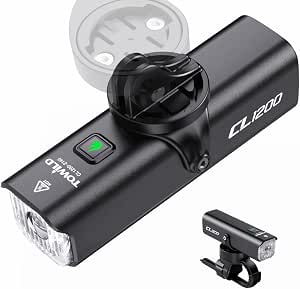 | Best for Long Commuter Shifts | Maximum output: 1,200 lumens | Battery capacity: 5,000mAh | Run time at 300 lumens: Up to 10 hours | VIEW LATEST PRICE | See Our Full Breakdown |
| out-front bike light | Maximum output | Water resistance | Mounting | Power source |
|---|---|---|---|---|
| Ravemen FR1500 SE Bike Light | 1500 lumens | IPX6 | Integrated stack mount; above or below the mount | Battery powered |
| ROCKBROS 1000 Lumens Bike Head | 1000 lumens | IPX6 | Handlebar mount; forward or reverse installation | Rechargeable battery |
| RAVEMEN FR1100 SE/FR500 Bike H | 500 lumens | IPX6 | Compatible Garmin/Wahoo mounting base; out-front mount not included | USB-C rechargeable |
| Magicshine Hori 1300S 1300LM B | 1300 lumens | IPX6 | Dual mount; above or below bars | — |
| Garmin Varia UT 800 Smart Head | 800 lumens | IPX6 | Dual out-front mount | Battery powered |
| TOWILD CL1200 Bike Light | 1,200 lumens | IPX6 | — | — |
More Details on Our Top Picks
Ravemen FR1500 SE Bike Light – 1500 Lumen Headlight, Garmin/Wahoo/Bryton Compatible
The FR1500 SE is the strongest choice here for riders who want a bright, broad beam for dark roads, rather than a light mainly meant to help traffic notice them. Its 1500-lumen output exceeds the Magicshine Hori 1300S and the TOWILD CL1200, while the downward-angled spread is intended to light the road without sending the beam straight into oncoming eyes. The integrated stack mount keeps a compatible cycling computer and light aligned in one cockpit setup, and auto on/off helps avoid leaving the light running after a stop. The tradeoff is mounting: the front bracket is sold separately, and it will not fit the Wahoo ELEMNT BOLT aero front mount. At 4.96 ounces, it is also not the lightest option. I’d choose it for output and computer integration, not a ready-to-mount package.
Pros:- 1500-lumen maximum output and a wide, downward-angled beam suit riding in genuinely dark conditions.
- Integrated stack mount is designed to align the light with Garmin, Wahoo, or Bryton computers.
- Up to 60 hours of runtime and three flash modes support visibility-focused rides.
- Movement-responsive auto on/off and IPX6 protection add convenience in wet weather.
Cons:- Front mounting bracket is not included, so a compatible bracket is needed before installation.
- Incompatible with the Wahoo ELEMNT BOLT aero front mount.
- At 4.96 ounces, it is heavier than the compact RAVEMEN FR500.
Best for: Night riders with Garmin, Wahoo, or Bryton computers who want a high-output beam and already have a compatible front bracket.
Not ideal for: Riders who need a complete mounting setup in the box or use the Wahoo ELEMNT BOLT aero front mount.
- Maximum output:1500 lumens
- Power source:Battery powered
- Mounting:Integrated stack mount; above or below the mount
- Water resistance:IPX6
- Runtime:Up to 60 hours
- Weight:4.96 ounces
- Dimensions:3.54 × 2.32 × 1.08 inches
- Materials:Aluminum and plastic
Our verdict“Choose the FR1500 SE if you want the highest stated output in this group and can supply its compatible front bracket.”
ROCKBROS 1000 Lumens Bike Headlight USB-C Rechargeable Front Light
The ROCKBROS 1000 makes sense for riders who want a conventional handlebar-mounted light with useful ride information built in. Its digital display shows battery level and mode, giving a clearer read on remaining charge than the product details provide for the RAVEMEN FR500. Smart and manual modes let riders choose automatic operation or direct control, while temperature and low-voltage management are designed to moderate output and protect the battery. Its 1000-lumen maximum sits below the FR1500 SE and Magicshine Hori 1300S, so it is less suited to riders prioritizing the brightest beam for unlit routes. The flexible forward or reverse handlebar installation and IPX6 rating make it a practical everyday option, but the information supplied does not specify runtime or beam shape. I’d pick it for its display and straightforward mounting, not for verified long-run performance.
Pros:- Digital display shows battery level and selected mode while riding.
- Smart and manual modes offer automatic operation as well as direct control.
- Temperature and low-voltage management are designed to moderate output and battery use.
- IPX6 protection and forward or reverse handlebar mounting suit varied everyday setups.
Cons:- Its 1000-lumen maximum is lower than the FR1500 SE and Magicshine Hori 1300S.
- No runtime figure or beam pattern is provided in the product information.
- Handlebar mounting does not provide the integrated cycling-computer stack setup offered by the FR1500 SE.
Best for: Commuters and recreational riders who want a 1000-lumen handlebar light with a visible battery indicator and USB-C charging.
Not ideal for: Riders tackling long, unlit routes who need a stated runtime or a dedicated out-front computer-compatible mounting system.
- Maximum output:1000 lumens
- Power source:Rechargeable battery
- Battery capacity:2800 mAh
- Charging:USB-C
- Mounting:Handlebar mount; forward or reverse installation
- Water resistance:IPX6
- Weight:136 g
- Material:Aluminum
Our verdict“Pick the ROCKBROS if a battery display and adaptable handlebar installation matter more than maximum output or a specified runtime.”
RAVEMEN FR1100 SE/FR500 Bike Headlight Compatible with Garmin/Wahoo Computers, 270° Wide-Angled Bicycle Front Light for Night Urban Riding & Daytime Warning, Auto On and Off, 6 Modes
The RAVEMEN FR500 is aimed at urban riders who value being noticed from the sides as well as from directly ahead. Its 270-degree viewing angle and three flash options give it a broader visibility role than the FR1500 SE, which is the stronger pick when illuminating a dark route is the main task. The FR500 offers up to 500 lumens of steady output, so it can light city streets but is not the right substitute for a higher-output beam on fast, unlit descents. At 3.52 ounces, it is lighter than the FR1500 SE, and the computer-ready stack format keeps the cockpit tidy. Mounting compatibility takes extra attention: the out-front mount is not included, Bryton needs a separately sold adapter, and the original Wahoo ELEMNT BOLT aero mount is unsupported. This is a compact urban visibility light, with setup caveats.
Pros:- 270-degree viewing angle helps make the rider visible from the sides as well as the front.
- Six modes include three flashing options for daytime visibility.
- At 3.52 ounces, it weighs less than the FR1500 SE.
- Auto on/off and the ability to operate while charging support practical commuting use.
Cons:- 500-lumen maximum is below the FR1500 SE, ROCKBROS 1000, and Magicshine Hori 1300S.
- Out-front mount is not included.
- Bryton compatibility requires a separately sold adapter, and the original Wahoo ELEMNT BOLT aero mount is unsupported.
Best for: City commuters and road riders who want a compact computer-mounted light with broad side visibility and daytime flash modes.
Not ideal for: Riders who need a high-output light for fast riding on unlit roads or a ready-to-install out-front mount.
- Maximum output:500 lumens
- Power source:USB-C rechargeable
- Mounting:Compatible Garmin/Wahoo mounting base; out-front mount not included
- Water resistance:IPX6
- Viewing angle:270 degrees
- Lighting modes:6, including 3 flashing options
- Weight:3.52 ounces
- Dimensions:3.23 × 2.36 × 1.14 inches
Our verdict“Choose the FR500 for side visibility and a light computer-stack setup in town, rather than for maximum illumination on dark roads.”
Magicshine Hori 1300S 1300LM Bike Light with Mount for Garmin/Wahoo
The Magicshine Hori 1300S stands apart by pairing a 1300-lumen high beam for darker routes with a cutoff low beam intended to reduce glare for city traffic. That makes it more adaptable between road and trail-style riding than the FR500, which tops out at 500 lumens and emphasizes wide-angle visibility. Its dual-mount design also accommodates a cycling computer or compatible action camera, while the included remote can control the light and compatible Magicshine rear lights together. That rear-light pairing requires a separately sold taillight, so the control system is not a complete front-and-rear package by itself. The aluminum build, USB-C charging, and vibration-based auto on/off add practical features, but the claimed high output still trails the FR1500 SE. I’d favor this model for beam versatility and cockpit flexibility rather than maximum brightness.
Pros:- Cutoff low beam is designed for city use, while the 1300-lumen high beam suits darker riding.
- Dual mount supports a cycling computer or compatible action camera in an out-front setup.
- Included remote can control the front light and compatible Magicshine rear lights.
- Aluminum construction, USB-C charging, and IPX6 protection suit regular all-weather use.
Cons:- 1300-lumen maximum is lower than the FR1500 SE.
- Compatible rear light for LightSync control is sold separately.
- The product information does not state a runtime figure.
Best for: Riders who split time between city streets and darker roads or trails, and want a cutoff low beam plus computer or camera mounting.
Not ideal for: Riders whose priority is the highest available output or who want a fully integrated front-and-rear light system without buying a separate taillight.
- Maximum output:1300 lumens
- Battery capacity:3200 mAh
- Charging:USB-C
- Mounting:Dual mount; above or below bars
- Computer compatibility:Garmin, Wahoo, and Bryton
- Water resistance:IPX6
- Lighting settings:6
- Materials:Aluminum and plastic
Our verdict“Choose the Hori 1300S if you need both a city-friendly cutoff beam and stronger output for darker rides in one out-front setup.”
Garmin Varia UT 800 Smart Headlight with Dual Out-Front Mount
The Garmin Varia UT 800 is the clearest choice for riders already using a compatible Edge computer and who want the light to respond to their ride. It can adjust brightness based on ambient light, speed, and ride profile, and Edge pairing enables light control from the computer. That integration is more central here than on the ROCKBROS 1000, whose standout feature is its on-light battery and mode display. The UT 800 offers five modes and a stated 800-lumen maximum, but its steady high setting lasts only up to 1.5 hours; the product description cites up to four hours when paired with a compatible Edge and using automatic adjustments. That makes it less compelling for long rides at high output than the FR1500 SE, which claims up to 60 hours across its modes. Choose Garmin control over raw output or lengthy high-beam use.
Pros:- Compatible Edge computers can control the light and support automatic on/off behavior.
- Brightness adjusts to ambient light, speed, and ride profile when paired with a compatible Edge.
- Five modes include steady and flashing options for different riding conditions.
- Supplied dual out-front mount supports a streamlined handlebar setup.
Cons:- Steady 800-lumen output is specified for up to 1.5 hours.
- Its 800-lumen maximum is lower than the FR1500 SE, Hori 1300S, and ROCKBROS 1000.
- The most extensive automatic controls depend on a compatible Garmin Edge computer.
Best for: Garmin Edge riders who want computer-controlled brightness and automatic light behavior for urban and trail rides.
Not ideal for: Riders who need long stretches at maximum brightness, higher stated output, or computer-independent smart controls.
- Maximum output:800 lumens
- Power source:Battery powered
- Mounting:Dual out-front mount
- Water resistance:IPX6
- Lighting modes:5
- High-output runtime:Up to 1.5 hours at 800 lumens
- Weight:0.13 kg
- Material:Aluminum
Our verdict“Choose the Varia UT 800 if Garmin Edge integration matters more to you than high output or long runtime at full brightness.”
TOWILD CL1200 Bike Light
The TOWILD CL1200 suits commuters who want a substantial battery and a Garmin-style out-front setup without choosing the highest-output light in this lineup. Its 5,000mAh battery is rated for up to 10 hours at 300 lumens, or 2.75 hours at the full 1,200 lumens, giving riders a choice between longer commutes and a brighter beam. The stated cutoff beam is designed to reduce glare for oncoming road users, a practical distinction from lights focused mainly on raw output, such as the 1,500-lumen Ravemen FR1500 SE. It also supports upside-down mounting and can charge a phone or cycling computer. The tradeoffs are its 176 g weight and four-hour charge time; riders who prioritize lower weight or more output may prefer another option, while the mount compatibility and run-time range make this a useful everyday commuter pick.
Pros:- 5,000mAh battery offers a stated 10-hour run time at 300 lumens.
- Cutoff-style beam is designed to limit glare toward oncoming traffic.
- Compatible with Garmin quarter-turn mounts and includes a GoPro-compatible base.
- USB-C charging and the ability to charge a phone or cycling computer add commuter utility.
Cons:- At 176 g, it is heavier than a minimal out-front light setup.
- Full-output run time is stated at 2.75 hours, limiting its appeal for long rides at maximum brightness.
- A full charge takes about four hours.
Best for: Commuters who want long low- or medium-output run time, a cutoff beam, and compatibility with Garmin-style or GoPro mounting hardware.
Not ideal for: Riders prioritizing the lightest setup, the highest maximum output, or a quick recharge; the light weighs 176 g, tops out at 1,200 lumens, and takes about four hours to charge.
- Maximum output:1,200 lumens
- Battery capacity:5,000mAh
- Run time at 300 lumens:Up to 10 hours
- Run time at 600 lumens:Up to 5 hours
- Run time at 1,200 lumens:Up to 2.75 hours
- Charging:USB-C; approximately 4 hours
- Mount compatibility:Garmin quarter-turn and GoPro-compatible base
- Water resistance:IPX6
- Weight and material:176 g; aluminum
Our verdict“Choose the CL1200 if you value commuter-friendly battery life and a glare-conscious beam more than minimum weight or maximum output.”
How We Picked
I compared these lights around the jobs an out-front setup has to do: illuminate the rider’s path, stay securely positioned, fit the intended computer or action-camera mount, and suit the ride length and setting. I gave weight to stated lumen output, beam and side-visibility details, battery information, charging and control features where supplied, and the practical implications of each design. I also treated compatibility claims as a buying factor rather than assuming that all out-front mounts use the same interface.
The ranking favors useful balance and clear fit for a range of riders over the highest number on a box. The Ravemen FR1500 SE leads for its combination of stated output and named computer compatibility; the Garmin Varia UT 800 ranks higher for Garmin users than for riders outside that ecosystem. The remaining lights earn their places through distinct priorities—wide-angle urban visibility, a simple 1000-lumen option, Garmin/Wahoo mounting, or a listed 5000mAh battery. Product details vary, so I would confirm the exact mount, operating modes and runtime for the configuration being considered.
| out-front bike light | Power source | Mounting | Charging |
|---|---|---|---|
| Ravemen FR1500 SE Bike Light | Battery powered | Integrated stack mount; above or below the mount | — |
| ROCKBROS 1000 Lumens Bike Head | Rechargeable battery | Handlebar mount; forward or reverse installation | USB-C |
| RAVEMEN FR1100 SE/FR500 Bike H | USB-C rechargeable | Compatible Garmin/Wahoo mounting base; out-front mount not included | — |
| Magicshine Hori 1300S 1300LM B | — | Dual mount; above or below bars | USB-C |
| Garmin Varia UT 800 Smart Head | Battery powered | Dual out-front mount | — |
| TOWILD CL1200 Bike Light | — | — | USB-C; approximately 4 hours |
Factors to Consider When Choosing Best Out-front Bike Lights
Choosing an out-front light involves more than comparing lumen claims. I would start with the riding conditions and the mount already on the bike, then match brightness, beam shape and battery behavior to the actual route.
Match Beam Shape to Roads and Traffic
A high lumen figure does not tell you where the light lands or how much reaches the sides. On unlit roads, a controlled beam aimed down the route can help reveal the surface without sending unnecessary glare toward other road users. In city riding, side visibility and a beam that makes the bike noticeable at junctions may matter more than maximum distance. Do not assume that two lights with similar output illuminate the same area; lens design and mounting angle affect the result. If you ride mixed routes, look for usable modes that let you adjust the light for a dark lane and a lit street. Aim the lamp so it lights your path while avoiding direct glare into oncoming eyes.
Check the Mount Interface Before Buying
“Out-front” describes a position, not one universal attachment standard. A light may be designed for a Garmin-style quarter-turn interface, a Wahoo-compatible mount, or a GoPro-style connection, and an included mount does not guarantee it fits your existing computer bracket. Check both sides of the setup: how the lamp attaches to the mount and how the mount attaches to your handlebar or computer system. Also account for accessories stacked below the computer, since a light can obstruct a camera, alter computer access or leave too little room under the bar. A compatible adapter may solve the mismatch, but it adds parts and another connection that can loosen. Confirm the exact interface and included hardware before choosing a light for a crowded cockpit.
Treat Runtime as a Route-Planning Question
Maximum brightness is often the mode that draws the most power, so it may not be the setting you can use for an entire ride. Compare a light’s runtime at the mode you expect to use, not only its headline lumen output or battery capacity. A long commute with a dark section may call for a lower steady mode that lasts, while short rides may favor readily available high output. Battery capacity figures, such as the TOWILD’s listed 5000mAh, are useful context but do not establish runtime on their own. Leave a reserve for delays and colder conditions, which can reduce practical battery performance. If the manufacturer does not publish clear mode-by-mode runtimes, treat that missing detail as a tradeoff rather than guessing.
Choose Smart Controls Only If They Fit Your Setup
Automatic brightness or on-and-off behavior can reduce fiddling when light conditions change, but smart features are most useful when they work with the rider’s computer and habits. A feature tied to a particular ecosystem may add little for someone who uses a different brand or prefers manual control. Before paying extra for automation, check what devices it works with and whether the lamp can still be operated easily on its own. Simpler controls can be easier to use with gloves or during a quick stop, while more modes can make it harder to find the right setting by feel. For a first out-front light, prioritize understandable controls and a dependable mount over features you may not use. Riders who already rely on compatible electronics may get more benefit from an integrated setup.
Balance Size, Weight and Cockpit Space
A larger lamp or battery can support more output or longer use, but it also adds weight ahead of the bars and can crowd other accessories. That tradeoff matters most on lightweight road bikes, small handlebars and setups already carrying a computer or camera. Check the light’s dimensions and the position of its mount, not only its weight, because a low or forward placement can conflict with cables and bags. A compact setup can be easier to remove and carry when parking, while a larger unit may make sense for longer rides if its battery capacity serves a real need. Avoid buying by lumen count alone if the light will sit unused because it is awkward to mount or remove. Think about where you will store and charge it between rides as well.
Pay for Useful Features, Not Unneeded Maximums
More stated lumens, more modes and app-linked controls do not automatically make a better fit. Spend more when a feature solves a real problem, such as a compatible smart setup, a beam that suits unlit roads or battery capacity for longer trips. For regular daytime commuting, a wide-angle visibility feature may matter more than the highest available output. For occasional short rides, a straightforward rechargeable light may be easier to live with than a complex system. Compare what is included in the box, especially mounts and adapters, since a nominally compatible light may need extra hardware for your bike. The best value is the model that meets your route and mounting needs without paying for capabilities you will rarely use.
Frequently Asked Questions
Will any of these lights fit the out-front mount I already own?
Not necessarily: out-front mounts can use different interfaces, even when they occupy the same position on the handlebar. The Ravemen FR1500 SE and FR1100 SE/FR500 name Garmin and Wahoo compatibility, while the Magicshine Hori 1300S lists a Garmin/Wahoo mount and the TOWILD CL1200 cites Garmin/GoPro compatibility. The Garmin Varia UT 800 is supplied with a dual out-front mount, but that does not mean every existing bracket will suit it. Check the exact light-to-mount connection and the handlebar-side attachment before purchase. If an adapter is required, confirm that it supports the lamp’s weight and leaves enough space for your computer.
Is a 1500-lumen light always better than a 1000-lumen model?
No. The stated output can help compare lights, but it does not describe beam shape, glare control or how long a light can sustain that output. A well-suited lower-output setting may be more useful on familiar urban streets than maximum brightness, while an unlit route can call for more illumination. Battery runtime at the mode you plan to use is a better comparison than peak output alone. The ROCKBROS 1000 may suit riders who want a simpler stated-output choice, while the FR1500 SE gives more headline output for riders who need it. Match the light to the route rather than treating the largest number as the winner.
Should I choose the Garmin Varia UT 800 if I use a non-Garmin computer?
The UT 800’s strongest case is its smart-light approach and included dual out-front mount, so its appeal is clearest for riders already using Garmin equipment. A non-Garmin rider should check which functions remain available without that ecosystem and compare the mounting arrangement with a more broadly described option. The Ravemen FR1500 SE names Garmin, Wahoo and Bryton compatibility, while the Magicshine Hori 1300S specifies Garmin/Wahoo support. Compatibility of the physical mount does not necessarily mean all smart controls work with every computer. If you want a straightforward lamp rather than integrated control, a simpler model may be a better fit.
What should I prioritize for daytime commuting?
For daytime use, visibility from the sides and a setting that remains practical in traffic can matter more than maximum road illumination. The RAVEMEN FR1100 SE/FR500 stands out in this lineup for its stated 270-degree wide-angle design and daytime warning use. Still, check how its modes behave in daylight and whether you can operate them quickly while stopped. A bright front-facing beam alone may be less noticeable to vehicles approaching from an angle. Mount position also matters: keep the lamp visible around bags, baskets and other accessories. Choose a light you can leave mounted securely and recharge as part of your normal routine.
How much should I rely on battery capacity or a claimed waterproof design?
Battery capacity and waterproof claims are useful clues, but neither gives a complete picture of performance on your rides. The TOWILD CL1200 lists a 5000mAh battery, yet buyers still need mode-specific runtime information to judge whether it will last through a planned route. Waterproof wording also does not replace checking the manufacturer’s conditions for charging, port covers and care after wet rides. For any model, plan around a lower setting and keep a reserve rather than assuming peak output will last for the full trip. If you commute in changing weather, confirm the product’s stated protection details and avoid charging a wet light. These checks matter more than relying on a single battery number or broad weather claim.
Conclusion
For most riders who want a capable, broadly compatible starting point, I recommend the Ravemen FR1500 SE as best overall. The ROCKBROS 1000 is my best value-style pick for riders who want a straightforward 1000-lumen option, while the Garmin Varia UT 800 is the best premium-style choice for Garmin users who value its smart-light approach and included mount. New riders should start with the ROCKBROS 1000 if they want a simpler setup, after checking its mount fits their bike. For daytime city visibility, choose the RAVEMEN FR1100 SE/FR500; for a listed high-capacity battery and Garmin/GoPro mounting, look at the TOWILD CL1200. If your setup uses Garmin or Wahoo hardware and you want another compatible option, the Magicshine Hori 1300S deserves a closer look. My final check would be mount fit and runtime at your intended mode, since those details can matter more than a headline lumen figure.