
If you’re after the best 130mm triplet APO refractors for sharper, clearer astrophotos, we recommend models like Explore Scientific ED102, FCD100 127mm, and Askar 120APO for their exceptional optical quality, minimal aberrations, and versatile focal lengths. These scopes excel in delivering high-contrast images and precise color correction, ideal for deep-sky and planetary photography. Keep exploring as we highlight the key features and what makes each of these options stand out.
Key Takeaways
- High-quality ED and FCD glass elements minimize chromatic aberration for sharper, color-accurate astrophotography.
- Air-spaced triplet designs across models deliver superior optical correction and minimal aberrations.
- Focal lengths around 840mm support detailed planetary imaging, while wider fields suit deep-sky objects.
- Compatibility with stable mounts and accessories ensures precise tracking and optimal image quality.
- Lightweight, portable builds and included accessories make these scopes ideal for versatile astrophotography setups.
SVBONY SV550 Triplet APO Telescope (122mm F7 ED, 87mm Focus)
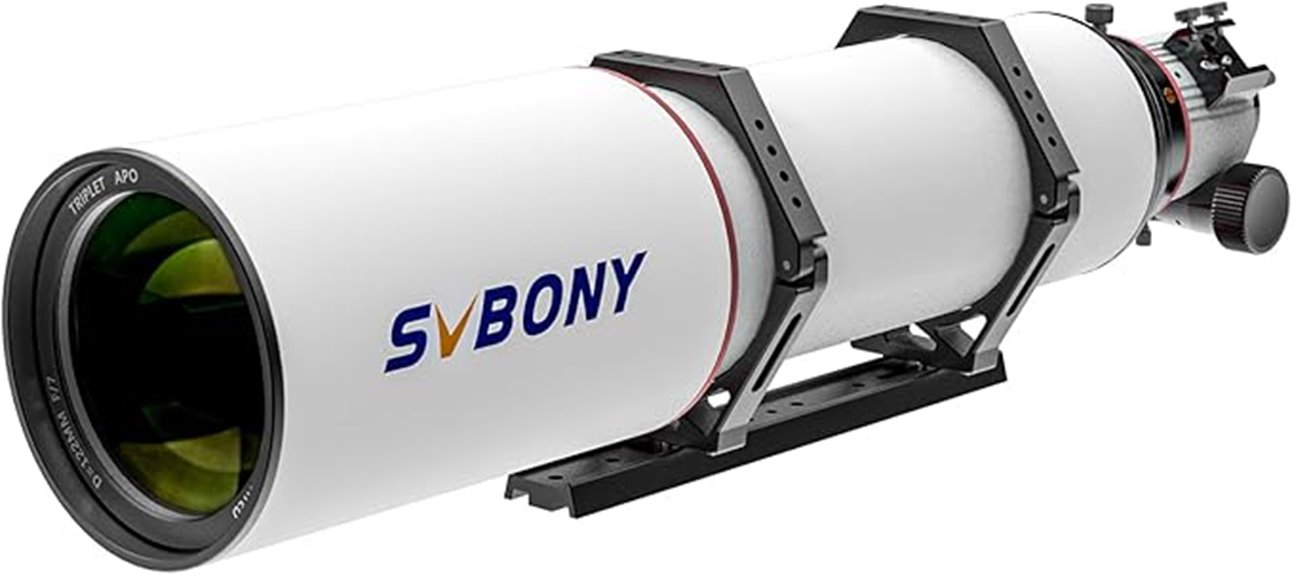
If you’re looking for a portable yet high-performance telescope for astrophotography, the SVBONY SV550 Triplet APO stands out. It features a 122mm aperture with an f/7 focal ratio and an 854mm focal length, perfect for capturing detailed deep-sky images. Weighing just 6.44kg, it includes a carrying case, making it travel-friendly. The FPL-51 triplet lens reduces chromatic aberration, ensuring sharp, clear images. Its 2.5-inch dual-speed focuser allows precise adjustments, vital for high-quality astrophotography. Whether you’re into deep-sky objects or visual observing, this versatile, lightweight scope offers excellent optical performance on the go.
Best For: amateur astronomers and astrophotographers seeking a portable, high-quality telescope for deep-sky imaging and visual observation.
Pros:
- Compact and lightweight design with included carrying case for easy portability
- High-quality FPL-51 triplet apochromatic lens reduces chromatic aberration for sharp images
- Precise 2.5-inch dual-speed focuser allows accurate focusing essential for astrophotography
Cons:
- Focal length of 854mm may require additional accessories for wide-field imaging
- Dovetail rail extension up to 300mm might limit stability without proper balancing
- As a specialized instrument, it may have a steeper learning curve for beginners unfamiliar with astro equipment
Explore Scientific ED102 Apochromatic Refractor Telescope

The Explore Scientific ED102 Apochromatic Refractor Telescope stands out as an excellent choice for amateur astronomers and astrophotographers seeking high-quality, portable optics. Its 102mm aperture and f/7 focal ratio, combined with a precision air-spaced triplet design, virtually eliminate chromatic aberration. Using genuine FCD1 HOYA ED glass and multi-layer coatings, it delivers sharp, high-contrast images of stars, nebulae, and galaxies. Although minor imperfections exist, like slight star shape issues, overall image quality remains impressive. Its compact, travel-friendly design, adjustable collimation, and excellent performance in light-polluted skies make it a versatile and valuable tool for both visual and astrophotography pursuits.
Best For: amateur astronomers and astrophotographers seeking a portable, high-quality apochromatic refractor with excellent image clarity and minimal chromatic aberration.
Pros:
- Virtually eliminates chromatic aberration thanks to air-spaced triplet design and ED glass
- Compact, travel-friendly size with adjustable collimation for precise focusing
- Excellent performance in light-polluted skies, producing sharp, detailed images
Cons:
- Slight optical imperfections such as star shape issues and airy disc misshape
- Focuser may have some backlash and slop, requiring upgrades for finer control
- Additional accessories like finders, filters, and extension tubes are needed for optimal use
Explore Scientific ED80 Triplet Refractor Telescope for Astrophotography

For amateur astronomers seeking exceptional optical performance in a portable package, the Explore Scientific ED80 Triplet Refractor Telescope stands out as an ideal choice for astrophotography. Its genuine FCD1 HOYA ED glass and multi-layer coatings deliver high-contrast, sharp images with minimal chromatic aberration. The air-spaced triplet design guarantees excellent color correction, making it perfect for capturing detailed views of the Moon, planets, and deep-sky objects. Compact and lightweight at just under six pounds, it’s easy to mount and transport. Its high-quality optics and solid build quality make it a reliable tool for both visual observing and astrophotography enthusiasts seeking crisp, vibrant images.
Best For: amateur astronomers and astrophotographers seeking a portable, high-quality apochromatic refractor for detailed lunar, planetary, and deep-sky imaging.
Pros:
- Exceptional optical quality with genuine FCD1 HOYA ED glass and multi-layer coatings for high-contrast, sharp images
- Virtually eliminates chromatic aberration due to its air-spaced triplet design, ideal for astrophotography
- Compact and lightweight, making it portable and easy to mount on various setups
Cons:
- Included mount may have some play and might require upgrades or modifications for better stability
- Some proprietary finder scope mounts may need adapters or specific finders, adding to setup complexity
- Minor manufacturing defects and sharp edges on the focuser require caution during handling
Explore Scientific FCD100 Series 80mm Air-Spaced Apochromatic Triplet Refractor Telescope
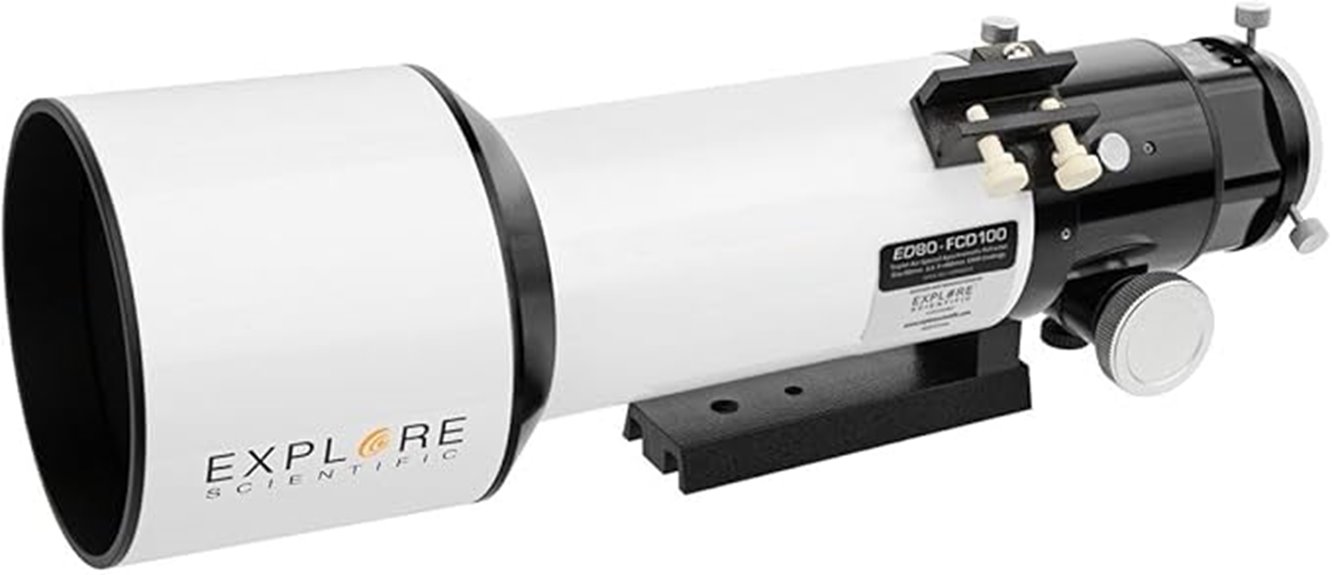
The Explore Scientific FCD100 Series 80mm Air-Spaced Apochromatic Triplet Refractor Telescope stands out as an excellent choice for astrophotographers seeking compact yet versatile optics. Its genuine Hoya FCD100 ED glass and multi-layer coatings deliver high-contrast, sharp images, virtually eliminating chromatic aberrations. With an 80mm aperture, f/6 focal ratio, and 480mm focal length, it captures more light than smaller scopes, making detailed imaging of planets, nebulae, and star clusters possible. Its lightweight design, measuring just 7 pounds, and features like a two-speed focuser and integrated dew shield make it a portable, reliable, and high-quality tool for both visual and astrophotography pursuits.
Best For: amateur astronomers and astrophotographers seeking a portable, high-quality apochromatic refractor for detailed planetary, lunar, and deep-sky imaging.
Pros:
- High-contrast, sharp images thanks to genuine Hoya FCD100 ED glass and multi-layer coatings
- Virtually eliminates chromatic aberrations for clear, detailed views
- Lightweight and compact at just 7 pounds, ideal for portability and quick setup
Cons:
- Limited aperture size may restrict deep-sky object brightness compared to larger telescopes
- Premium optical components and features can come with a higher price point
- Requires additional accessories (like mounting and tripod) for full functionality
Celestron StarSense Explorer DX 130AZ Telescope with Smartphone Dock

Ideal for beginners seeking an easy-to-use telescope, the Celestron StarSense Explorer DX 130AZ combines a 130mm Newtonian reflector with innovative smartphone technology. It features a manual altazimuth mount with dual slow-motion controls, an adjustable tripod, and comes with 10mm and 25mm eyepieces for 65x and 26x magnification. The telescope delivers bright, detailed views of the Moon, planets, and deep-sky objects. Its standout feature is the StarSense app that uses sky recognition and GPS-like technology to guide you to celestial targets. Simply dock your phone, follow on-screen prompts, and enjoy effortless object locating, making it perfect for beginners.
Best For: beginners and amateur astronomers seeking an easy-to-use, smartphone-integrated telescope with guided sky navigation.
Pros:
- User-friendly setup and assembly, ideal for newcomers
- Innovative StarSense app provides precise, GPS-like object location guidance
- Bright 130mm aperture offers detailed views of Moon, planets, and deep-sky objects
Cons:
- Manual altazimuth mount may be less stable for prolonged viewing sessions
- Smartphone docking and alignment require proper setup and calibration
- Limited to basic manual controls without automated tracking or GoTo capabilities
Explore Scientific FCD100 Series ED102 Refractor Telescope (OTA Only)

If you’re serious about astrophotography and need crisp, high-contrast images, the Explore Scientific FCD100 Series ED102 refractor telescope stands out as a top choice. It features a 102mm aperture and a fast f/7 focal ratio, delivering sharp, detailed views with minimal chromatic aberration thanks to genuine HOYA FCD100 ED glass and proprietary coatings. With a high resolution of 1.14 arcseconds, it’s perfect for precise imaging. Weighing just under 11 pounds, it’s portable and easy to handle. Designed as an air-spaced triplet, it offers excellent image clarity across the visible spectrum, making it ideal for astrophotographers seeking quality and performance.
Best For: astrophotographers and astronomers seeking high-precision, high-contrast images with minimal chromatic aberration in a portable, high-quality refractor telescope.
Pros:
- Utilizes genuine HOYA FCD100 ED glass with proprietary multi-layer coatings for superior image quality.
- High resolution of 1.14 arcseconds, ideal for detailed astrophotography and precise observations.
- Lightweight and portable at just under 11 pounds, making it easy to transport and set up.
Cons:
- OTA only, requiring additional mounting accessories or a compatible mount.
- Limited to optical functions; no included accessories such as mount, tripod, or eyepieces.
- Dimensions (28 x 10 x 9.5 inches) may require adequate storage space or transportation considerations.
SVBONY SV105 Telescope Camera for Astrophotography
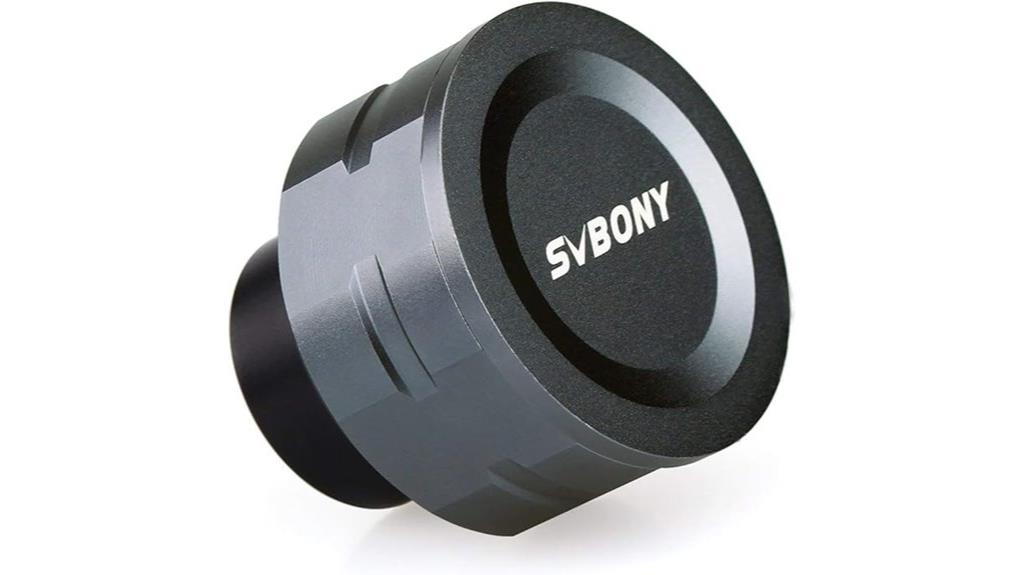
For beginners venturing into astrophotography, the SVBONY SV105 Telescope Camera offers an accessible entry point with its user-friendly design and high-quality imaging capabilities. Equipped with a 1/2.8-inch IMX307 CMOS sensor, it captures sharp images and smooth videos at up to 30 fps in 1080p, perfect for lunar, planetary, and terrestrial shots. Its dark light compensation technology helps improve clarity in low-light conditions. The plug-and-play setup works seamlessly with Windows, Linux, and Android devices, connecting via standard threaded interfaces. Simply point your telescope, record, and transfer images in real time—making it an ideal choice for those starting their astrophotography journey.
Best For: beginners and amateur astronomers looking for an easy-to-use, high-quality astrophotography camera compatible with multiple platforms.
Pros:
- User-friendly plug-and-play design that requires no driver installation
- High-quality 1/2.8-inch IMX307 CMOS sensor for clear images and smooth 1080p videos at 30 fps
- Compatible with Windows, Linux, and Android devices, supporting real-time capture and transfer
Cons:
- Not compatible with iOS mobile devices like phones or tablets
- Limited to 1080p resolution, which may not meet advanced astrophotography needs
- Requires additional software (e.g., Sharpcap, AstroDMx Capture) for full functionality
Celestron Omni XLT 120 Refractor Telescope

The Celestron Omni XLT 120 Refractor Telescope stands out as a superb choice for amateur astronomers who want high-quality optics combined with precise tracking capabilities. Its hand-selected optical glass and fully multi-coated StarBright XLT lenses deliver exceptional brightness and sharpness, making detailed celestial views possible. Mounted on the reliable Celestron CG-4 German equatorial mount, it offers smooth, accurate tracking with setting circles and slow-motion controls. The package includes essential accessories like a finderscope, steel tripod, star diagonal, and eyepiece, plus educational software. All these features make it a versatile, user-friendly telescope perfect for both visual observing and astrophotography.
Best For: amateur astronomers seeking high-quality optics and precise tracking for detailed celestial viewing and astrophotography.
Pros:
- Hand-selected optical glass with fully multi-coated StarBright XLT lenses for superior brightness and clarity
- Accurate Celestron CG-4 German equatorial mount with slow-motion controls and setting circles for precise tracking
- Complete accessory package including finderscope, steel tripod, star diagonal, and educational software for an all-in-one observing experience
Cons:
- May require some initial setup and calibration for optimal tracking accuracy
- Heavier and larger than beginner-focused telescopes, potentially less portable
- Primarily designed for visual observing, so astrophotography may require additional accessories or modifications
SVBONY SV550 Telescope with Accessories
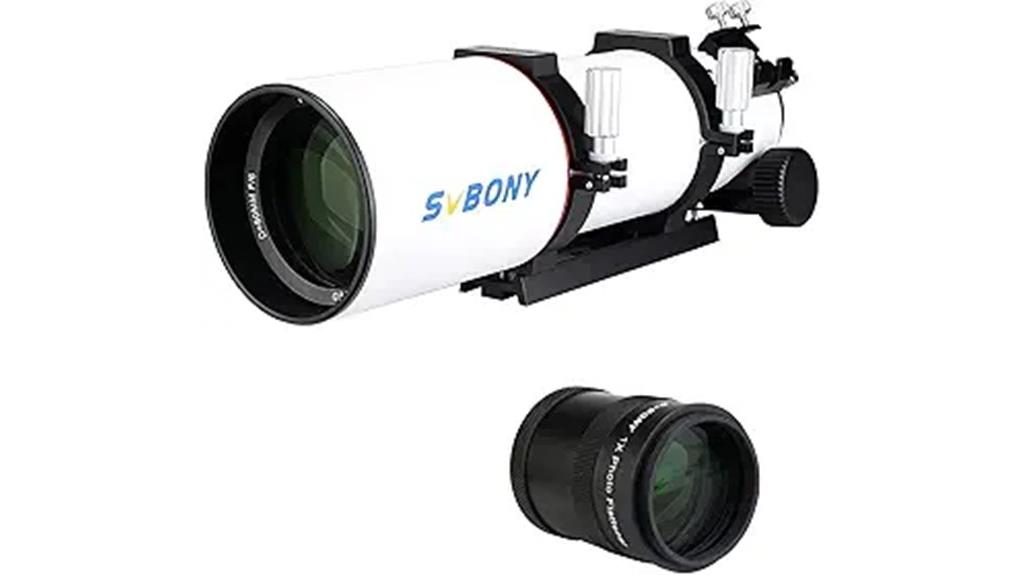
Designed with deep sky astrophotographers in mind, the SVBONY SV550 Telescope offers exceptional optical performance at an affordable price. Its 80mm F6 APO triplet delivers sharp, flat images suitable for both half-frame and full-frame cameras, thanks to its 480mm focal length and included field flattener. The package features a lightweight magnesium alloy focusing seat, a M63 extension tube, and M48 adapter ring, ensuring proper back focus. Its internal light barriers minimize stray light, enhancing image clarity. Weighing just 8.8 pounds, it’s portable yet stable, making it ideal for astrophotographers seeking a high-quality, budget-friendly refractor for capturing detailed deep-sky objects.
Best For: amateur and semi-professional deep sky astrophotographers seeking an affordable, high-quality refractor for wide-field imaging and celestial object capturing.
Pros:
- Exceptional optical performance with sharp, flat images suitable for full-frame and half-frame cameras
- Lightweight magnesium alloy focusing seat reduces weight while maintaining durability
- Internal light barriers effectively minimize stray light, enhancing image clarity
Cons:
- Focal locks may function more as “focus please don’t move” knobs, risking accidental shifts
- Internal dust may be present but is easily cleaned
- Mount/rail is somewhat low profile, which could contact the focuser when balancing
Askar 120APO Telescope for Astrophotography
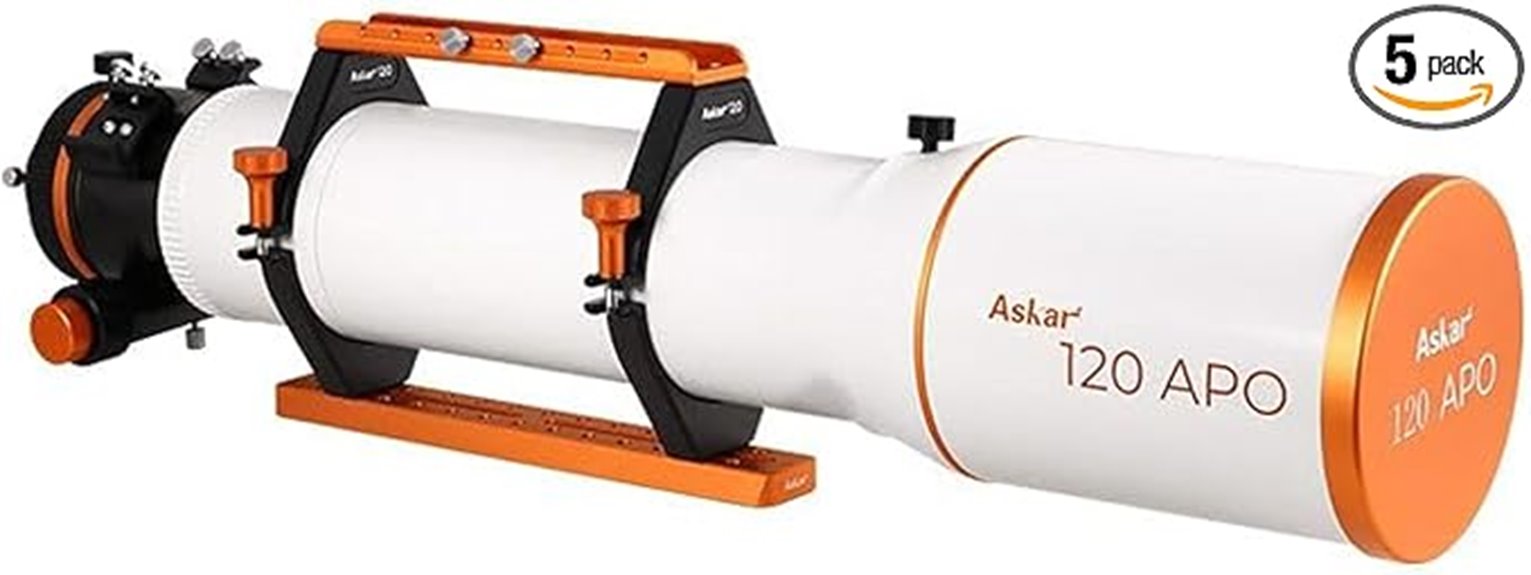
If you’re looking for a compact, high-performance telescope that delivers sharp, color-accurate images, the Askar 120APO is an excellent choice for astrophotographers. Its 120mm aperture and 840mm focal length provide bright, detailed views with minimal chromatic aberration thanks to the triplet air-spaced APO design, including ED glass. Weighing just 5.7kg, it’s portable and easy to handle, making it perfect for field use. The package includes tube rings, a handle, dovetail plate, and a durable carrying case. Overall, the Askar 120APO offers excellent optical quality and versatility for both astrophotography and visual observing.
Best For: Amateur astrophotographers and astronomers seeking a portable, high-quality refractor telescope for detailed celestial imaging and observation.
Pros:
- Minimal chromatic aberration due to triplet APO design with ED glass for sharp, color-accurate images
- Lightweight and compact at 5.7kg, ideal for field use and portability
- Comes with comprehensive accessories including tube rings, handle, dovetail plate, and carrying case
Cons:
- Slightly higher cost compared to basic refractors with similar aperture
- Limited to 120mm aperture, which may not be suitable for deep-sky objects requiring larger apertures
- Requires compatible mount and accessories for optimal astrophotography setup
Explore Scientific FCD100 Series 127mm Refractor Telescope

Looking for a portable yet capable refractor for both planetary and deep-sky astrophotography? The Explore Scientific FCD100 Series 127mm f/7.5 Carbon Fiber Triplet ED APO delivers solid optical performance in a lightweight design. With a 127mm aperture, 952mm focal length, and a f/7.5 ratio, it offers good versatility and a limiting magnitude of 13. Its carbon fiber triplet ED lens system aims for excellent color correction and sharp images. Weighing just 14 pounds and measuring 33.25 inches, it’s fairly portable. However, some users find its views comparable to less expensive reflectors, and customer feedback highlights concerns about value and support.
Best For: amateur astronomers seeking a portable, high-quality refractor suitable for both planetary and deep-sky observations despite mixed reviews on value and support.
Pros:
- Lightweight and portable at 14 pounds, easy to transport for field use
- Carbon fiber triplet ED APO lens system offers good color correction and sharp images
- Versatile f/7.5 focal ratio suitable for planetary and deep-sky viewing
Cons:
- Customer reviews indicate the views are comparable to less expensive reflectors, questioning optical value
- Reports of poor customer service and difficulty obtaining warranty support
- Some users find the focuser and diagonal could be improved for the price point
Factors to Consider When Choosing 130MM Triplet APO Refractors for Astrophotography
When selecting a 130mm triplet APO refractor for astrophotography, we need to consider several key factors. These include optical performance quality, focal length flexibility, and how easily the mount integrates with the setup. Additionally, portability, price, and overall value play vital roles in making the right choice for your imaging needs.
Optical Performance Quality
Optical performance quality is vital when selecting a 130mm triplet APO refractor for astrophotography, as it directly impacts image sharpness, color accuracy, and contrast. High-quality models use ED or FCD glass elements to virtually eliminate chromatic aberration, resulting in crisper, more accurate colors. The air-spaced triplet design offers superior correction across the visible spectrum, enhancing detail and contrast. Focal ratios around f/7 or f/7.5 strike a balance between light-gathering power and manageable exposure times, improving image clarity. Multi-layer coatings on optical surfaces boost light transmission, reduce reflections, and increase contrast, producing brighter celestial images. Precise collimation and minimal optical imperfections, like star shape aberrations, are vital for achieving high-resolution, high-quality astrophotography results.
Focal Length Flexibility
Focal length flexibility is a key consideration when choosing a 130mm triplet APO refractor for astrophotography because it directly affects the types of objects you can capture and the level of detail you can achieve. Longer focal lengths, like 840mm or more, deliver higher magnification, making them ideal for detailed planetary and double star imaging. Shorter focal lengths, around 480mm, provide a wider field suitable for deep-sky objects like galaxies and nebulae. Many refractors come with interchangeable accessories such as focal reducers and field flatteners, allowing us to adapt focal length easily. This versatility enables us to optimize our setup for different targets, whether aiming for expansive wide-field shots or high-magnification planetary images, making the telescope more multi-purpose and efficient.
Mount Compatibility Ease
Choosing a 130mm triplet APO refractor that’s compatible with your mount is essential for successful astrophotography. First, check that the telescope’s dovetail plate matches your mount’s saddle, whether Vixen or Losmandy, to ensure secure attachment. It’s also important to verify that your mount can support the telescope’s weight—including accessories like cameras and focusers—without compromising stability. Aim for a mount with a payload capacity at least 20-30% higher than the combined weight, helping to balance the setup and reduce strain during long exposures. Additionally, confirm that your mount offers precise tracking and guiding capabilities, especially given the focal length of a 130mm APO, to capture sharp images. Ultimately, consider if any adapters or rings are needed for seamless connection to your existing mount system.
Portability and Setup
When selecting a 130mm triplet APO refractor for astrophotography, portability and ease of setup are crucial factors to take into account. A lightweight design, featuring a magnesium alloy focusing seat and compact dimensions, makes transportation easier and setup quicker. Foldable or retractable features, such as dew shields, help reduce the overall size, enhancing travel convenience. Quick assembly with minimal components allows us to start observing or imaging faster, especially during spontaneous sessions. Mounting options like dovetail plates and lightweight tripods improve stability without adding bulk, which is essential for precise astrophotography. Carrying cases and included accessories also facilitate safe transport and rapid deployment in various outdoor environments, making these telescopes practical choices for mobile astronomers.
Price and Value
Price and value are critical considerations when selecting a 130mm triplet APO refractor for astrophotography. Higher prices often reflect better optical quality, build, and included accessories, but they don’t always guarantee better value. Comparing features like ED glass quality, focuser precision, and coatings helps determine if a more expensive model truly offers enhanced performance. Budget options might produce decent images but often lack advanced features such as high-precision focusers or sturdy mount compatibility, which impacts long-term usability. It’s vital to factor in the cost of additional accessories like mounting rings, adapters, and filters, as these are often necessary for maximum performance. Customer reviews and ratings can also shed light on real-world value, showing whether the scope’s performance justifies its price.
Frequently Asked Questions
How Do Triplet APO Refractors Compare in Image Color Correction?
Triplet APO refractors excel in color correction, delivering much sharper, more accurate images with minimal chromatic aberration. We’ve found that their advanced lens design effectively eliminates color fringing, especially around bright objects, resulting in crisper, true-to-life astrophotos. Compared to doublets, triplets provide superior correction, making them a top choice for astrophotographers who prioritize high image quality and detailed, vibrant captures.
What Maintenance Is Required for 130MM Triplet APO Telescopes?
Back in the day, maintaining a 130mm triplet APO requires regular care. We keep the lenses clean with a soft brush and proper cleaning solutions, avoiding harsh chemicals. It’s also essential to check and tighten screws periodically, keep the scope in a dry environment to prevent fungus, and calibrate the mount for stability. Proper storage in a padded case helps preserve optical quality and guarantees smooth operation.
Are There Specific Mounts Best Suited for These Refractors?
We recommend using equatorial mounts, like the German Equatorial Mount (GEM), for 130mm triplet APO refractors. These mounts offer precise tracking essential for astrophotography, minimizing star trails and blurring. Look for mounts with smooth, high-capacity motors and stable tripods. Additionally, auto-guiding compatibility can enhance tracking accuracy. We find that investing in quality mounts makes a significant difference in capturing sharp, clear images with these telescopes.
How Does Aperture Size Influence Astrophotography Results?
Aperture size directly impacts astrophotography results by determining how much light our telescope collects. Larger apertures, like 130mm, gather more light, resulting in brighter, more detailed images of faint celestial objects. They also improve resolution and contrast, helping us capture sharper, clearer pictures. However, bigger apertures can mean more weight and cost, so we balance size with our mounting capabilities and budget for ideal astrophotography.
What Accessories Enhance the Performance of 130MM Triplet APOS?
To unseal the full potential of your 130mm triplet APO, we recommend enhancing it with a high-quality field flattener or reducer—think of these as magic wands that clear up starry skies. Pair your scope with a robust mount, precise auto-guiders, and good filters to sharpen details and reduce noise. These accessories work together like a symphony, transforming your astrophotography into breathtaking images that truly capture the universe’s wonder.
Conclusion
Choosing the right 130mm triplet APO refractor is like finding the perfect lens for our vision—it sharpens our view of the universe. We’ve seen how each model can transform starry nights into breathtaking images, much like turning a blurry sketch into a vivid masterpiece. With the right telescope in hand, we’re not just observing; we’re capturing the cosmos’s beauty, one clear, sharp image at a time.