The best magnetic bike lights combine a secure, easy-to-remove mount with enough visibility for the routes you ride. My best overall pick is the Magicshine HORI1300S Front and SEEMEE 150 MAG Rear Set, which pairs a front-and-rear setup with a dedicated magnetic rear light. The ROCKBROS Magnetic Rechargeable Tail Light stands out for riders who want brake sensing, while the Ascher USB-Rechargeable Light Set is a straightforward option for people seeking a basic pair. The main tradeoffs are magnetic convenience versus mount security, rear-light features versus a complete set, and extra brightness versus charging needs. Read on for how the nine options differ and which type of rider each one suits.

Get bike and ride gear delivered free with Prime
- Fast, free delivery on millions of items
- Prime Video, Amazon Music and more included
- Member-only deals all year
Key Takeaways
- The Magicshine HORI1300S and SEEMEE 150 MAG set is the most complete starting point in this lineup because it combines a front light with a magnetic rear light rather than focusing only on the rear.
- Brake sensing is concentrated in rear-light picks such as the ROCKBROS, Magicshine VIVEE 50, and Gaciron LOOP-100; it adds a signaling feature, but does not replace a strong front beam.
- The SHEAWA induction taillight takes a different approach from rechargeable models, making power source and operating expectations a key part of the choice.
- Several options are sold as front-and-rear sets, including Cuvccn, Ascher, and ACSO, while other picks target riders who already have a front light.
- Magnetic convenience alone does not settle the choice: check how the mount attaches to your bike, whether the light is easy to remove, and whether its features match your routes.
| Magicshine HORI1300S Front and SEEMEE 150 MAG Rear Bike Light Set |  | Best Overall Magnetic Light Set | Included lights: HORI1300S front light and SEEMEE 150 MAG rear light | Maximum front output: 1300 lumens | Maximum rear output: 150 lumens | VIEW LATEST PRICE | See Our Full Breakdown |
| SHEAWA Self-Powered Magnetic Induction Bicycle Taillight |  | Best Battery-Free Pick | Power source: Magnetic induction; no battery required | Mounting: Fork-mounted light with spoke magnets | Maximum magnet clearance: 5 mm | VIEW LATEST PRICE | See Our Full Breakdown |
| ROCKBROS Magnetic Rechargeable Bike Tail Light with Brake Sensor |  | Best for Brake-Sensing Features | Maximum output: 100 lumens | Lighting modes: 7 | Mounting: Seat mount with magnetic attachment | VIEW LATEST PRICE | See Our Full Breakdown |
| Cuvccn Rechargeable Bicycle Light Set with Front and Rear Lights | 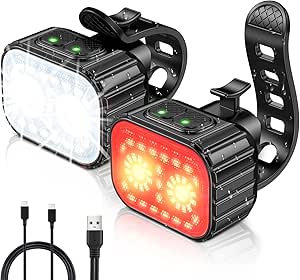 | Best Value Complete Set | Included lights: Front and rear lights | Listed light output: 300 lm + 100 lm; maximum listed as 400 lumens | Lighting modes: Front: 8; rear: 12 | VIEW LATEST PRICE | See Our Full Breakdown |
| Ascher USB-Rechargeable Bike Light Set with Front Headlight and Rear Taillight |  | Best for Simple Strap-On Setup | Maximum light output: Up to 300 lumens | Lighting modes: 4 per light | Front battery capacity: 2000 mAh | VIEW LATEST PRICE | See Our Full Breakdown |
| ACSO Rechargeable Front and Rear Bike Lights |  | Best Complete Set for Versatile Use | Included lights: 1 white front light and 1 red rear light | Front light output: 600 lumens | Front light runtime: Up to 4 hours on high; up to 13 hours on low | VIEW LATEST PRICE | See Our Full Breakdown |
| Magicshine VIVEE 50 360° Bike Taillight with Brake Sensor |  | Best for Side Visibility and Brake Alerts | Maximum light output: 50 lumens | Runtime: 4–25 hours, depending on mode | Light modes: 5 | VIEW LATEST PRICE | See Our Full Breakdown |
| Gaciron LOOP-100 Bike Tail Light with Brake Sensing |  | Best Value Rear Light for Brake Sensing | Maximum light output: 100 lumens | Lighting modes: 7 | Runtime: Up to 40 hours | VIEW LATEST PRICE | See Our Full Breakdown |
| Magicshine SEEMEE 150 MAG USB-C Rechargeable Rear Bike Light Set |  | Best Premium Magnetic Two-Light Set | Quantity: 2 lights | Maximum light output: 150 lumens | Light sources: Red and white | VIEW LATEST PRICE | See Our Full Breakdown |
| magnetic bike light | Water resistance | Mounting | Charging | Weight |
|---|---|---|---|---|
| Magicshine HORI1300S Front and | IPX6 | — | USB-C | — |
| SHEAWA Self-Powered Magnetic I | IPX7 | Fork-mounted light with spoke magnets | — | 3.04 oz |
| ROCKBROS Magnetic Rechargeable | IPX6 | Seat mount with magnetic attachment | — | — |
| Cuvccn Rechargeable Bicycle Li | IPX6 | — | USB; approximately 2.5–3 hours listed | 77 g |
| Ascher USB-Rechargeable Bike L | IPX4 | Silicone straps for handlebar and seat post | — | — |
| ACSO Rechargeable Front and Re | IP65 | Handlebar mount with tool-free installation | USB-C; approximately 2 hours for a full charge | — |
| Magicshine VIVEE 50 360° Bike | IPX6 | Magnetic quick-release mount | USB-C; about 1.5 hours with a 5V/1A source | 31 g |
| Gaciron LOOP-100 Bike Tail Lig | IPX6 | Magnetic; saddle or seatpost | USB-C | 22.68 g listed item weight; 25 g in description |
| Magicshine SEEMEE 150 MAG USB- | IPX6 | Magnetic and Garmin-style quick-release | USB-C | 180 g |
More Details on Our Top Picks
Magicshine HORI1300S Front and SEEMEE 150 MAG Rear Bike Light Set
The HORI1300S and SEEMEE 150 MAG make the strongest all-around choice here for riders who want a coordinated front-and-rear setup with magnetic convenience at the back. The front light’s 1300-lumen output and high-beam and anti-glare low-beam options suit varied routes, while the included remote lets me control both lights without reaching for each unit. Compared with the simpler Cuvccn set, this one adds a magnetic rear mount, a remote, and a sharper choice of front optics, though the Cuvccn offers more listed front and rear modes. The rear light releases quickly for charging or storage, but its 150-lumen maximum is modest beside the front light. I’d also factor in that the paired one-touch control depends on keeping the included remote handy.
Pros:- Remote controls power and modes on both lights.
- Front light offers high beam and an anti-glare low beam with a sharp cutoff.
- Magnetic rear light releases without tools.
- USB-C charging and IPX6 water resistance support regular riding in wet conditions.
Cons:- Rear light tops out at 150 lumens, far below the front light’s maximum output.
- The described one-touch control of both lights requires the included remote.
Best for: Riders who want a capable front beam, a quick-release magnetic rear light, and one remote for both lights.
Not ideal for: Riders who want an especially bright rear light or prefer to operate every function directly on the lights without carrying a remote.
- Included lights:HORI1300S front light and SEEMEE 150 MAG rear light
- Maximum front output:1300 lumens
- Maximum rear output:150 lumens
- Control:Included MJ-6558 remote for one-touch power and mode control
- Rear mount:Magnetic, Garmin-style mount
- Charging:USB-C
- Water resistance:IPX6
- Warranty:2 years
Our verdict“Choose this set for a versatile front beam and convenient magnetic rear light, provided the 150-lumen rear output meets your needs.”
SHEAWA Self-Powered Magnetic Induction Bicycle Taillight
The SHEAWA takes a different approach to magnetic bike lights: spoke magnets generate illumination by induction as the wheel turns, so there is no battery to charge. That makes it a practical fit for riders who want a rear light without a charging routine. Unlike the rechargeable ROCKBROS tail light, it has no brake sensor, selectable modes, or stated long-runtime setting; its output instead increases with speed and it flashes twice per wheel revolution. The fork-mounted design also asks for more careful setup than the seat-mounted magnetic ROCKBROS: the spoke magnets and light need to align with no more than 5 mm of clearance. Its IPX7 rating is the strongest stated water-resistance rating among these five picks, but illumination depends on the wheel moving, so it is not a standalone light for stops or when the bike is parked.
Pros:- Magnetic induction powers the light without batteries or charging.
- Output gets brighter as riding speed increases.
- IPX7 water resistance is suited to wet-weather use.
- Included rubber mats help fit different forks.
Cons:- Illumination depends on the wheel turning and is not a standalone light when stopped.
- Spoke magnets and light require careful alignment within 5 mm of clearance.
- Offers one setting and no user-selectable flash patterns.
Best for: Commuters who want a rear light that needs no battery charging and are comfortable aligning spoke magnets with a fork-mounted unit.
Not ideal for: Riders who need light while stationary, want multiple modes, or do not want to fine-tune magnet clearance during installation.
- Power source:Magnetic induction; no battery required
- Mounting:Fork-mounted light with spoke magnets
- Maximum magnet clearance:5 mm
- Flash pattern:Two flashes per wheel revolution
- Water resistance:IPX7
- Settings:1
- Weight:3.04 oz
- Warranty:1 year
Our verdict“Pick the SHEAWA if avoiding batteries matters more than having steady illumination at stops or the extra features of a rechargeable light.”
ROCKBROS Magnetic Rechargeable Bike Tail Light with Brake Sensor
For riders who want more than a basic magnetic rear marker, the ROCKBROS combines seven modes with a brake sensor that triggers a high-intensity flash when speed drops. Its automatic mode also responds to ambient light and vibration, then sleeps after two minutes parked and wakes when it senses movement. Compared with the battery-free SHEAWA, this is a feature-rich rechargeable alternative that can keep signaling without relying on wheel rotation—but it does require charging. The claimed up-to-36-hour runtime applies only to single-flash mode, so riders using other settings should expect a different run time. Its stated visibility distance is up to 656 feet, but buyers seeking a complete lighting system will need a separate front light; the Magicshine HORI1300S set includes one.
Pros:- Magnetic attachment allows tool-free mounting.
- Brake sensor triggers a high-intensity flash when speed drops.
- Seven modes and automatic light-and-vibration response offer flexible operation.
- Single-flash mode has a stated runtime of up to 36 hours.
Cons:- The stated 36-hour runtime applies only to single-flash mode.
- Automatic mode sleeps after two minutes parked, while manual mode does not.
- Sold as a rear light, so a separate front light is needed.
Best for: Riders who want a magnetic rear light with a brake-sensing flash, automatic behavior, and multiple modes.
Not ideal for: Riders who need a front-and-rear set, want a battery-free light, or expect the 36-hour runtime across all modes.
- Maximum output:100 lumens
- Lighting modes:7
- Mounting:Seat mount with magnetic attachment
- Charging port:USB-C
- Water resistance:IPX6
- Brake sensor:Activates a high-intensity flash for 1.5 seconds when speed drops
- Maximum stated runtime:Up to 36 hours in single-flash mode
- Stated visibility distance:Up to 656 ft (200 m)
Our verdict“Choose the ROCKBROS for brake-sensing and automatic rear-light features, not as a replacement for a complete front-and-rear set.”
Cuvccn Rechargeable Bicycle Light Set with Front and Rear Lights
The Cuvccn is a straightforward front-and-rear rechargeable set for riders who want broad mode choice without a separate remote or magnetic rear-light system. It lists eight front modes and 12 rear modes, with independent switches, so each light can be adjusted on its own. Compared with the Magicshine HORI1300S set, it lacks the remote, magnetic quick release, and specialized high- and low-beam optics; in return, it supplies a simpler handlebar-mounted pair with a long stated front runtime of up to 58 hours in slow-flash mode. That figure is mode-specific, and the rear runtime is listed separately at up to 25 hours. The product data also gives differing charging-time estimates, so I would not treat the approximate 2.5–3-hour figure as a precise expectation.
Pros:- Includes both front and rear lights with independent switches.
- Offers eight front modes and 12 rear modes.
- IPX6 water resistance and a covered USB port support wet-weather riding.
- Tool-free handlebar mounting also suits some non-cycling uses.
Cons:- Does not include the magnetic rear mount or shared remote found on the Magicshine set.
- Front and rear lights have different battery capacities and stated runtimes.
- Charging-time estimates vary in the product description.
Best for: Budget-conscious riders who want a rechargeable front-and-rear pair with independent controls and several lighting modes.
Not ideal for: Riders who specifically want a magnetic quick-release rear light, remote control, or a strong dedicated front beam for darker routes.
- Included lights:Front and rear lights
- Listed light output:300 lm + 100 lm; maximum listed as 400 lumens
- Lighting modes:Front: 8; rear: 12
- Battery capacity:Front: 1100 mAh; rear: 350 mAh
- Maximum stated runtime:Front: up to 58 hours in slow-flash mode; rear: up to 25 hours
- Charging:USB; approximately 2.5–3 hours listed
- Water resistance:IPX6
- Weight:77 g
Our verdict“Choose the Cuvccn for a mode-rich rechargeable pair, but pick the Magicshine set if magnetic rear mounting and remote control matter more.”
Ascher USB-Rechargeable Bike Light Set with Front Headlight and Rear Taillight
The Ascher set is the uncomplicated choice for riders who value quick, tool-free strap mounting over magnetic release. Silicone straps attach the front and rear lights to a handlebar and seat post, making this pair easier to move between bikes than a fixed mount. The front headlight reaches up to 300 lumens and rotates horizontally, while the rear light adjusts vertically; that flexibility helps aim each light, though it does not give the front the beam options of the Magicshine HORI1300S. Each light has four modes, but runtime varies by mode, and the stated IPX4 rating is less robust than the IPX6 protection listed for the Cuvccn and Magicshine sets. I’d choose Ascher for a basic rechargeable pair, not for riders prioritizing stronger weather protection or magnetic rear mounting.
Pros:- Includes both front and rear lights.
- Silicone strap mounts allow tool-free fitting and removal.
- Four modes on each light provide basic lighting choices.
- Front rotates horizontally and rear adjusts vertically for aiming.
Cons:- IPX4 water resistance is lower than the IPX6 rating listed for the Cuvccn and Magicshine sets.
- Battery life varies by mode, with different capacities and runtimes for front and rear.
- Does not provide a magnetic rear mount or shared remote.
Best for: Casual riders who want a basic rechargeable front-and-rear set that can be fitted or removed quickly with silicone straps.
Not ideal for: Riders seeking a magnetic quick-release rear light, higher stated water resistance, or a more specialized front beam for darker routes.
- Maximum light output:Up to 300 lumens
- Lighting modes:4 per light
- Front battery capacity:2000 mAh
- Front battery life:5–12 hours, depending on mode
- Rear battery capacity:330 mAh
- Rear battery life:9–16 hours, depending on mode
- Mounting:Silicone straps for handlebar and seat post
- Water resistance:IPX4
Our verdict“Pick Ascher for an easy-to-transfer rechargeable pair, but choose an IPX6 or magnetic option if weather protection or quick rear-light release is a priority.”
ACSO Rechargeable Front and Rear Bike Lights
The ACSO set is the practical pick for riders who need both a front and rear light in one package and value quick, tool-free mounting. Its 600-lumen front light offers five modes, while the rear has eight modes and a stated runtime of up to 100 hours. Compared with the single rear lights in this roundup, such as the Gaciron LOOP-100, ACSO covers both ends of the bike; it also includes magnetic clips and a headlamp bracket for use off the bike. The tradeoff is that high mode lasts only up to four hours, so frequent bright rides mean more charging. The rear light’s output in lumens is not specified, making direct brightness comparisons harder. IP65 protection and USB-C charging round out a flexible, though less specialized, package.
Pros:- Includes both a 600-lumen front light and a red rear light.
- Five front modes and eight rear modes give riders lighting options for different conditions.
- USB-C charging, with two charging cables included.
- IP65 water resistance and tool-free mounting; included accessories support alternate uses.
Cons:- Front runtime is up to four hours on high, which may not suit long rides at maximum output.
- Rear light lumen output is not specified.
- The ABS construction may feel less substantial than an aluminum-bodied option such as the Gaciron LOOP-100.
Best for: Commuters and recreational riders who want a front-and-rear set with tool-free mounting and lights they can also use while walking or camping.
Not ideal for: Riders seeking a rear light with a clearly stated lumen output or a front light for long rides on high mode.
- Included lights:1 white front light and 1 red rear light
- Front light output:600 lumens
- Front light runtime:Up to 4 hours on high; up to 13 hours on low
- Rear light runtime:Up to 100 hours
- Lighting modes:5 front modes; 8 rear modes
- Charging:USB-C; approximately 2 hours for a full charge
- Water resistance:IP65
- Mounting:Handlebar mount with tool-free installation
Our verdict“Choose the ACSO set if you want a versatile, front-and-rear lighting package; skip it if you need quantified rear brightness or extended high-mode runtime.”
Magicshine VIVEE 50 360° Bike Taillight with Brake Sensor
The Magicshine VIVEE 50 is a focused rear-light choice for riders who want their presence visible from the sides as well as behind. Its 360° halo lens and brake-sensing alert add signals that the simpler rear light on the ACSO set does not list, while automatic sleep and vibration wake can reduce unnecessary drain between rides. At just 31 g, it is also lighter than the two-light Magicshine SEEMEE 150 MAG Combo, though that set offers red and white lights and a higher stated maximum output. VIVEE’s 50 lumens and five modes suit visibility-oriented urban riding, not riders seeking the brightest rear beam in this group. Runtime ranges from four to 25 hours by mode, and its remote cannot be paired on its own; compatible Magicshine equipment is needed for syncing.
Pros:- 360° halo lens helps make the rider visible from the sides.
- Brake sensing adds an alert when slowing down.
- Automatic sleep and vibration wake can reduce needless operation between rides.
- Lightweight 31 g body, USB-C charging, and IPX6 water resistance.
Cons:- Maximum output is 50 lumens, below the 100-lumen Gaciron LOOP-100 and 150-lumen SEEMEE 150 MAG Combo.
- The compatible front light and remote are sold separately.
- The remote cannot pair with this light alone.
Best for: Urban commuters who want a lightweight rear light with side visibility, brake alerts, and automatic wake from vibration.
Not ideal for: Riders who need a front light, a high-output rear beam, or standalone remote control without compatible Magicshine lights.
- Maximum light output:50 lumens
- Runtime:4–25 hours, depending on mode
- Light modes:5
- Weight:31 g
- Charging:USB-C; about 1.5 hours with a 5V/1A source
- Water resistance:IPX6
- Mounting:Magnetic quick-release mount
- Auto on/off:Sleeps after 5 minutes of inactivity and wakes with vibration when brake sensing is enabled
Our verdict“Pick the VIVEE 50 for a light, side-visible rear setup with brake alerts, but choose the Gaciron LOOP-100 if higher stated output matters more.”
Gaciron LOOP-100 Bike Tail Light with Brake Sensing
The Gaciron LOOP-100 balances a clear output figure with a compact magnetic mount, making it a straightforward choice for riders who want a dedicated rear light rather than a full set. Its 100-lumen output is double the VIVEE 50’s stated maximum, and its brake sensing briefly raises brightness when slowing—useful as an extra cue to traffic. The VIVEE counters with a 360° halo lens and automatic sleep-and-wake functions, while the LOOP-100 offers seven modes and a longer stated maximum runtime of up to 40 hours. The aluminum-alloy housing and IPX6 rating suit exposed daily use, but using the brake warning increases power consumption. The listed weight also varies between 22.68 g and 25 g, so I would not treat either figure as exact.
Pros:- Up to 100 lumens, with seven lighting modes.
- Brake sensing briefly boosts brightness when braking is detected.
- Magnetic mounting supports saddle or seatpost installation.
- USB-C charging, up to 40 hours of runtime, and IPX6 water resistance.
Cons:- Brake-warning use increases power consumption.
- Published weight differs between 22.68 g and 25 g.
- It is a rear light only, unlike the front-and-rear ACSO set.
Best for: Commuters who want a compact, magnetic rear light with brake sensing, multiple modes, and a stated output above 50 lumens.
Not ideal for: Riders who need a front light included or want a single, consistent published weight for planning a lightweight setup.
- Maximum light output:100 lumens
- Lighting modes:7
- Runtime:Up to 40 hours
- Battery capacity:420 mAh
- Charging:USB-C
- Mounting:Magnetic; saddle or seatpost
- Water resistance:IPX6
- Weight:22.68 g listed item weight; 25 g in description
Our verdict“Choose the LOOP-100 for a compact, higher-output magnetic rear light with brake sensing, provided its variable weight listing is not a concern.”
Magicshine SEEMEE 150 MAG USB-C Rechargeable Rear Bike Light Set
The Magicshine SEEMEE 150 MAG Combo suits riders building a compatible lighting setup who want two lights and flexible quick-release mounting. Its red and white LEDs support use as a taillight or daytime running light, while magnetic and Garmin-style mounts accommodate different setups. Unlike the single-purpose Gaciron LOOP-100, this pair can serve more than one position or lighting role; the Gaciron, however, specifies a 100-lumen rear output and up to 40 hours of runtime, figures not supplied for this combo. USB-C, mode memory, and a battery indicator simplify routine use, but LightSync control depends on compatible lights or a remote. At a stated maximum of 150 lumens, this set emphasizes flexible mounting and ecosystem features rather than a front-and-rear kit or fully specified performance figures.
Pros:- Two lights with red and white LEDs for taillight or daytime-running-light use.
- Magnetic and Garmin-style quick-release mounting options.
- USB-C charging, mode memory, and battery indication.
- IPX6 water resistance and compatibility with specified Magicshine and helmet devices.
Cons:- Maximum output is 150 lumens, and the supplied data does not specify runtime.
- LightSync requires compatible lights or a remote.
- The pair does not provide the clearly identified front headlight and rear taillight combination offered by the ACSO set.
Best for: Cyclists who already use compatible Magicshine, Garmin-style, or listed helmet equipment and want two quick-release lights with red and white LEDs.
Not ideal for: Buyers seeking a complete front-and-rear bicycle set, published runtime details, or LightSync control without compatible equipment.
- Quantity:2 lights
- Maximum light output:150 lumens
- Light sources:Red and white
- Charging:USB-C
- Water resistance:IPX6
- Mounting:Magnetic and Garmin-style quick-release
- Weight:180 g
- Compatible devices:ALLTY 800 V2.0, ALLTY 1200, ALLTY 1200U, MJ-6558 remote, LUMOS Ultra Fly, and Ultra Aero helmets
Our verdict“Choose the SEEMEE 150 MAG Combo if mounting flexibility and compatibility with your existing gear matter more than a complete front-and-rear set or published runtime.”
How We Picked
I compared these nine options around the parts of a magnetic light purchase that affect daily use: mounting and removal, whether the listing offers a front-and-rear solution or a rear light only, charging or power approach, and rider-facing features such as brake sensing. I also looked at how clearly each product serves a distinct need, from a fuller lighting setup to a simple backup or feature-focused rear light. I did not treat a feature list as proof of real-world brightness, runtime, or weather performance where those details were not established.
The ranking favors picks that cover more of a rider’s practical needs without making the buyer piece together a setup. That puts the Magicshine HORI1300S and SEEMEE 150 MAG set first as the most rounded choice in this lineup. Rear-only models rank by the specific advantage they offer, while basic light sets remain useful for simplicity but do not match the focused magnetic or brake-sensing features of the specialist options. I also account for tradeoffs: a rider who already owns a front light may prefer a rear-only pick, while a newcomer may value a matched set more.
| magnetic bike light | Charging | Water resistance |
|---|---|---|
| Magicshine HORI1300S Front and | USB-C | IPX6 |
| SHEAWA Self-Powered Magnetic I | — | IPX7 |
| ROCKBROS Magnetic Rechargeable | — | IPX6 |
| Cuvccn Rechargeable Bicycle Li | USB; approximately 2.5–3 hours listed | IPX6 |
| Ascher USB-Rechargeable Bike L | — | IPX4 |
| ACSO Rechargeable Front and Re | USB-C; approximately 2 hours for a full charge | IP65 |
| Magicshine VIVEE 50 360° Bike | USB-C; about 1.5 hours with a 5V/1A source | IPX6 |
| Gaciron LOOP-100 Bike Tail Lig | USB-C | IPX6 |
| Magicshine SEEMEE 150 MAG USB- | USB-C | IPX6 |
Factors to Consider When Choosing Best Magnetic Bike Lights
Choosing a magnetic light is not just a question of how quickly it attaches. I’d match the mount, lighting coverage, and power approach to the bike and routes first, then decide whether extras such as brake sensing earn their place. These checks help avoid buying a convenient light that does not fit your setup.
Check What the Magnet Attaches To
“Magnetic” can describe how the light connects to its own bracket, not necessarily how the bracket connects to the bike. Before ordering, confirm whether the mount uses a strap, clamp, or another attachment method and whether it fits your seatpost, handlebar, or rack. A magnetic release is handy for taking a light indoors, but the fixed mount still needs to suit the shape and space on your bike. If you ride rough surfaces, check how the product is intended to stay secured during vibration rather than assuming a quick-release design will fit every ride. A common mistake is choosing by the word magnetic alone and discovering that the included hardware does not suit the intended mounting spot.
Decide Whether You Need a Pair or a Rear Light
A rear light improves your visibility from behind, while a front light helps you be seen from the front and may illuminate the path depending on its beam. Those jobs are not interchangeable, so a rear-only model makes sense mainly if your front-light setup is already handled. A matched set, such as the Magicshine HORI1300S and SEEMEE 150 MAG or the Cuvccn and Ascher sets, can simplify buying for someone starting from scratch. However, a set is not automatically the best fit if you already own a capable light for one end of the bike. Decide what is missing before paying for duplicate equipment.
Match the Light to Your Route and Riding Conditions
Visibility needs change between lit urban streets, dark paths, and daytime rides, so a product name or a single brightness figure cannot tell the whole story. Look for usable modes and clear information about how the front beam is intended to work; avoid assuming every front light is designed to illuminate an unlit road. For the rear, think about how visible your bike needs to be from behind and whether the mounting position is exposed or partly blocked by a bag or rack. If you ride in rain, check the maker’s stated weather protection rather than inferring it from a sealed-looking body. Choose for your least forgiving regular route, not only the easiest ride you take.
Treat Brake Sensing as an Extra Signal
Brake-sensing rear lights, including the ROCKBROS, Magicshine VIVEE 50, and Gaciron LOOP-100, can add a signal when you slow down. That may be useful in stop-and-go traffic or when riders follow closely, but it does not replace a steady rear light or a front light. Check how the feature activates and whether the product information explains its behavior; do not assume all sensors respond in the same way. Riders on quiet routes may get more value from a simpler light that is easy to charge and mount. Pay extra for sensing only when the feature addresses a regular part of your riding.
Plan for Charging and Power Habits
Rechargeable lights suit riders who can build charging into their routine, but they need attention before longer rides. Check the charging connection and the manufacturer’s runtime information for the modes you expect to use; runtime can vary by mode, and a headline figure may not reflect your usual setting. The SHEAWA induction taillight differs from the USB-rechargeable models, so read how its power system works before assuming it will behave like a conventional rechargeable light. A spare or easily charged light can be more useful than extra features if you often forget to recharge. Match the power approach to your habits rather than choosing on convenience claims alone.
Choose the Right Balance of Simplicity and Features
Extra modes, sensors, and charging details can help, but each adds something to learn or maintain. A beginner may prefer a clearly matched front-and-rear set with uncomplicated operation, while a regular commuter may value quick removal or brake sensing more. Think about who will use the light, how often it will move between bikes, and whether you need to take it indoors after parking. If your main concern is a backup light, a simple set can be a better fit than a specialist rear model. Spend more attention on secure mounting and dependable everyday use than on features you are unlikely to activate.
Frequently Asked Questions
Are magnetic bike lights secure enough for rough roads?
Magnetic attachment can make a light quick to remove, but security depends on the full mounting system and how it is fitted to the bike. Check whether the magnet joins the lamp to a bracket and how that bracket attaches to your seatpost or handlebar. If you ride over rough surfaces, follow the maker’s mounting instructions and check the fit before setting off. A magnetic design should not be treated as theft protection when the bike is parked. For a valuable light, remove it when leaving the bike unattended.
Should I choose a magnetic rear light or a front-and-rear set?
Choose a rear-only light if your front light already meets your needs and you mainly want a quick-release rear option. A set is more practical if you are building a lighting setup from scratch or want both ends covered with one purchase. The Magicshine HORI1300S and SEEMEE 150 MAG set is the roundup’s strongest all-around set, while the ROCKBROS and other specialist rear picks focus on rear-light features. Check that the front light is suited to your routes; a rear light cannot illuminate your path. Avoid buying a set that duplicates a light you already use.
Is brake sensing worth choosing over a simpler rear light?
Brake sensing is most relevant if you ride around traffic, stop frequently, or often have riders close behind you. It adds a change in signaling when slowing, but it does not make a rear light a substitute for predictable riding or a front beam. The ROCKBROS, Magicshine VIVEE 50, and Gaciron LOOP-100 are the feature-led choices in this group. If you ride quieter routes or want the simplest setup, a standard rear light may be easier to manage. Compare the sensor behavior and operating details rather than assuming the feature works identically across models.
What should I check before buying a magnetic light for two different bikes?
Check the mount dimensions and attachment method for both bikes, including seatpost shape, handlebar space, and any bags or racks that could block the light. A quick-release lamp can move between bikes easily only if each bike has a compatible place for its bracket. Confirm whether the package includes the mounting parts you need for both setups or if an extra bracket is required. Also consider whether you want to move one light back and forth or keep a light on each bike. A second mounting point can save time if you switch bikes often.
How should I choose between USB-rechargeable and induction-powered lights?
Start with how the light gets power and what routine you can maintain. USB-rechargeable models need periodic charging, so check the connector, charging instructions, and stated runtime for the modes you use. The SHEAWA induction taillight uses a different power approach from the USB-rechargeable options, so confirm the maker’s explanation before buying if you expect conventional charging. Neither label alone tells you how long a light will operate or whether it suits your ride length. Pick the system whose upkeep you are most likely to follow consistently.
Conclusion
For the broadest recommendation, I’d choose the Magicshine HORI1300S Front and SEEMEE 150 MAG Rear Set as the best overall because it covers both ends of the bike and gives the rear light a magnetic role. Riders looking for a feature-focused rear light should compare the ROCKBROS Magnetic Rechargeable Tail Light with the Magicshine VIVEE 50 and Gaciron LOOP-100, especially if brake sensing matters on their routes. For best value, the Ascher USB-Rechargeable Set is a sensible starting point for buyers who want a basic front-and-rear pair without specialist rear-light features. Beginners may prefer a matched set such as Ascher or Cuvccn, while riders seeking a different power approach can investigate the SHEAWA induction taillight. If you already own a front light, focus on the rear-only options instead of buying duplicate coverage; the right choice depends on your mounting fit, route, and charging habits.